












The jaw is tight. The temples ache. The first sip of cold water makes a tooth pull back. These aren’t unconnected morning complaints, they’re the classic signs of sleep bruxism, which is the involuntary grinding or clenching of teeth during sleep.
At Partha Dental, dentists across 120+ clinics in South India see the consequences of untreated grinding regularly. A PubMed-indexed study on IT professionals in Bangalore found 59% reported bruxism, with stress as the strongest predictor. High-pressure schedules and poor sleep create exactly the conditions where grinding takes hold.
This blog by our experts covers how to stop teeth grinding in sleep naturally, five remedies that work, and when natural approaches aren’t enough.
How Do You Know You’re Grinding Your Teeth In Your Sleep?
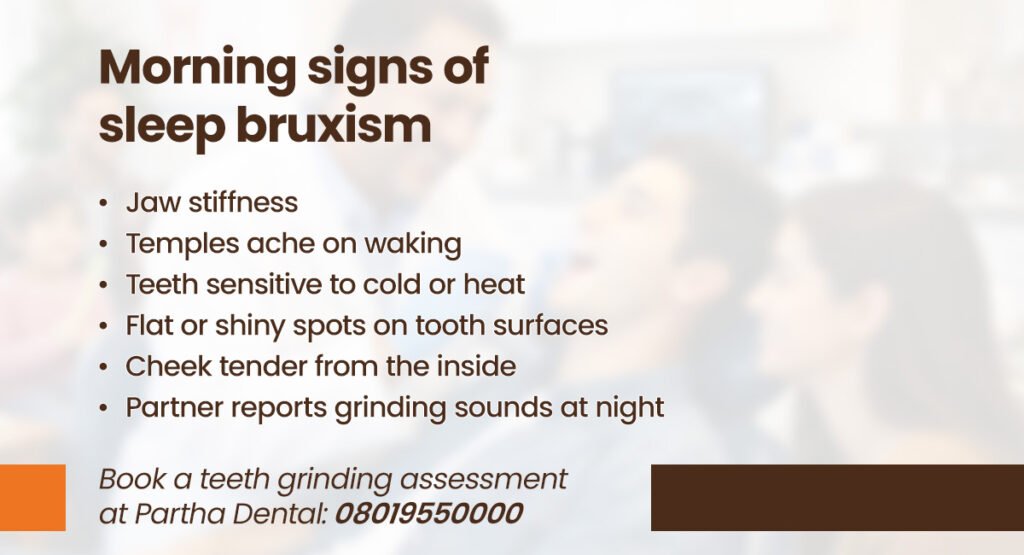
Grinding happens during sleep, so the only evidence is what’s left by morning or what someone sleeping nearby hears. The most common morning signs are:
- A sore jaw that loosens up as the day goes on
- Headaches sitting at the temples or behind the eyes
- Teeth that feel sensitive to temperature when they didn’t before.
- Some people notice their cheek feels tender from the inside, where it’s been pressed against the teeth during clenching.
- Others feel their ear is blocked or their jaw clicks when they open their mouth wide.
What partners notice is different: an audible grinding sound, like two surfaces rubbing together, usually in the first half of the night.
What the dentist at the best dental clinic in Chennai finds is different again.
- Flat or shiny spots on the biting surface of teeth are the earliest sign.
- The edges of front teeth lose their natural shape and start to look straight across rather than slightly rounded.
- Existing fillings or crowns can crack under the pressure.
One distinction worth knowing: grinding and clenching aren’t the same thing. Grinding involves movement, clenching involves sustained pressure with no movement. Clenchers are quieter and harder for a partner to detect. Both cause damage.
5 Remedies for Teeth Grinding That Work Naturally
Not all remedies for teeth grinding work at the same speed. Two work the same night. Three build up over weeks. But both matter.
- Warm compress before sleep
The masseter is the jaw muscle that does the grinding. It sits along the jawline and is one of the strongest muscles in the body relative to its size. When it’s tight, grinding is more likely and more forceful.
A warm compress held against the jaw for 10 minutes before lying down releases tension in the masseter before sleep begins.
- Use a warm (not hot) cloth or a heat pack.
- Press gently along the jawline from the ear to the chin.
- Jaw release position
Most people who grind hold their teeth lightly together during the day without realising it. This keeps the masseter in a low-level contraction for hours.
The correct resting jaw position is:
- Lips closed
- Teeth slightly apart
- Tongue resting on the roof of the mouth.
- Practice holding this for 10 seconds, several times throughout the day.
It takes about two weeks to start overriding the default clenching habit.
- Magnesium in the evening
Magnesium is a natural muscle relaxant. Some research suggests low magnesium levels may increase involuntary muscle activity, including jaw clenching during sleep.
Food sources available in a typical Indian diet:
- Pumpkin seeds
- Almonds
- Spinach
- Bananas
- Rajma (kidney beans)
Magnesium isn’t a cure for grinding. It’s a supportive measure that reduces muscle reactivity, particularly when teeth grinding is stress-related.
- Cut caffeine and alcohol six hours before sleep
Caffeine is a stimulant that keeps the nervous system active. It has a half-life of five to six hours, meaning half the caffeine from a 4pm chai is still circulating at 10pm.
Alcohol has the opposite effect on the surface: it makes falling asleep easier. But it disrupts sleep architecture in the second half of the night, which is when grinding tends to be most active.
Cutting both six hours before bed is more effective.
- Stop chewing gum during the day
Chewing gum trains the jaw muscles to stay active. An hour of gum chewing is an hour of masseter exercise. By the end of the day the muscle is conditioned to keep working, and that conditioning carries into sleep.
Patients who grind heavily and chew gum regularly are essentially rehearsing the grinding motion during waking hours. Stopping gum removes that priming effect.
What to Do When Natural Remedies Won’t Stop Teeth Grinding?
Natural remedies work reliably when stress and sleep quality are the primary drivers. Still they don’t fix every case. These three situations need a different approach.
- When the bite is driving the grinding
Malocclusion, which is a misalignment between the upper and lower teeth, causes the jaw to search for a comfortable resting position during sleep. That searching motion is grinding.
If grinding has persisted despite several weeks of consistent natural remedies, a bite assessment is worth having. Tooth braces or clear aligners at the best dental hospital in Vijayawada correct the bite misalignment that natural remedies can’t.
- When sleep apnea is involved
Obstructive sleep apnea causes repeated breathing interruptions during sleep. Each interruption triggers a micro-arousal. Those micro-arousals activate the jaw muscles. The result is grinding that’s driven by an airway problem.
Natural dental remedies won’t address the airway. This needs a medical sleep assessment alongside dental care.
- When tooth damage is already significant
If enamel has worn significantly, if dental crowns have cracked, or if a tooth has become sensitive because grinding has thinned the enamel close to the inner layer, natural remedies are not enough on their own.
A custom night guard, which is an occlusal splint made by Partha Dental to fit the exact shape of your teeth, absorbs the grinding force and protects what remains while underlying causes are addressed.
Get a Teeth Grinding Assessment at Partha Dental.
If natural remedies haven’t resolved the jaw soreness, or if a dentist has already pointed out wear on your teeth, a proper assessment is the next step.
Partha Dental is one of the best dental clinic in Jayanagar for patients who want an honest evaluation of grinding damage and a treatment plan that addresses the cause, not just the symptom.
Partha Dental has treated over 15 lakh patients across South India. Book a consultation at your nearest clinic. Call: 08019550000.
Frequently asked questions
I wake up with a sore jaw every day. Could that be grinding?
Very likely yes. Morning jaw soreness that eases through the day is one of the most consistent signs of sleep bruxism. A dentist can confirm it by checking through a routine examination.
Can teeth grinding cause permanent damage?
It can. Enamel doesn’t grow back once it’s worn away. Sustained grinding over months or years flattens biting surfaces, thins enamel, cracks fillings, and in severe cases exposes the inner layer of the tooth to decay.
My child grinds their teeth at night. Is it serious?
Grinding in children is common, particularly between ages 3 and 10, and often resolves on its own as the jaw and bite develop. However, if the grinding is loud, frequent, or accompanied by morning complaints, a paediatric dental check-up is worthwhile.