









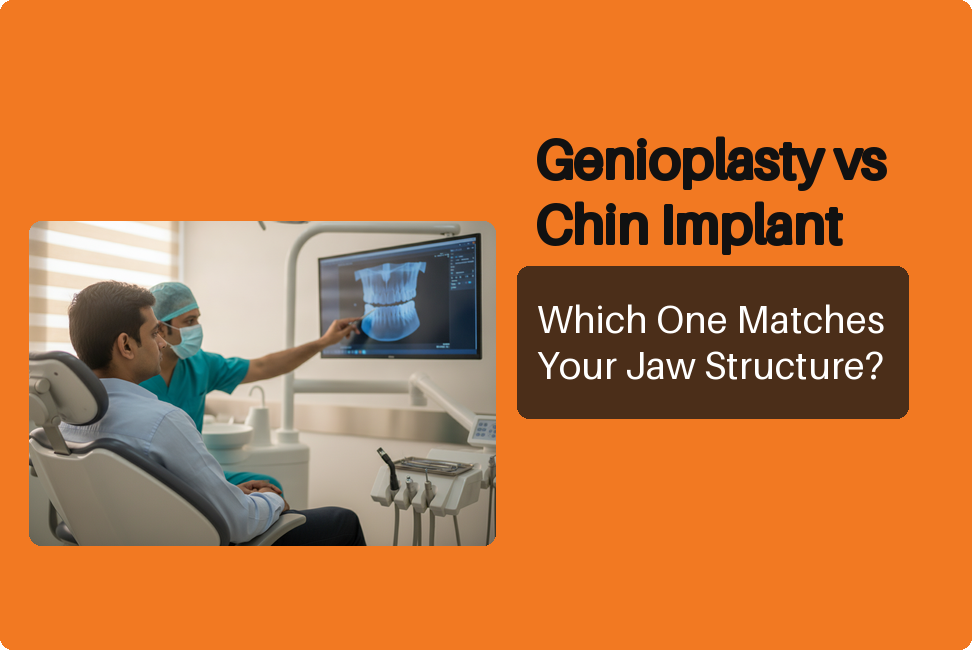
Genioplasty vs chin implant is the decision patients face when their chin sits back, looks short, or throws off facial balance. You have stared at profile photos, wondered whether your bite is part of the problem, and worried about looking artificial or facing a long recovery. The direct answer is this: choose a chin implant if you need straightforward forward projection with normal bite and chin height, and choose genioplasty if your chin needs vertical lengthening, asymmetry correction, or the bone itself must move. At Partha Dental, our Oral and Maxillofacial Surgeons assess chin position against your bite, airway, and facial proportions before recommending either path. Read on to see how each procedure works, how recovery differs, and which signs point to bone repositioning over implant placement.
Key takeaways
- A chin implant adds volume for projection but does not move bone, while genioplasty repositions your natural chin bone.
- Genioplasty corrects vertical deficiency, asymmetry, and large recessions that implants cannot address.
- Implant surgery is shorter and recovery is typically faster than genioplasty recovery.
- Your bite alignment and existing chin height are the main factors that rule out one option.
- Both procedures need 3D imaging and surgical planning; neither should be chosen from photos alone.
What does a chin implant actually do?
A chin implant is a solid, biocompatible insert placed through a small incision under the chin or inside the lower lip. It sits on the front of the mandible to push the chin outline forward. This works well when your chin is simply set back but has normal vertical height and your bite is already aligned. The result is predictable because the implant size is chosen before surgery and the change is limited to forward projection. At Partha Dental, Jaw Surgery consultations include implant sizing with 3D scans so you see the planned outline before any commitment.
Implants do not correct a chin that is too short top-to-bottom, tilted to one side, or severely recessed. They also cannot improve a deep bite or other dental occlusion problems because they do not change where the bone sits.
What does genioplasty change that implants cannot?
Genioplasty, also called osseous genioplasty or sliding genioplasty, cuts and moves a segment of your own chin bone. Because it uses your own tissue, it can advance the chin, lengthen it vertically, shorten it, or correct left-right asymmetry by moving different amounts on each side. This makes Genioplasty the choice when the problem is structural rather than purely cosmetic.
Patients with large recessions, vertical deficiency, or chin asymmetry often need bone movement to achieve balance. Since the bone heals in its new position, there is no foreign material to monitor long-term. The trade-off is a more involved procedure and a longer recovery than implant placement.
How do I know which procedure fits my chin?
The decision rests on three clinical checks: your bite relationship, your chin dimensions, and whether asymmetry is present. Here is how the options compare across the factors that matter most.
| Factor | Chin Implant | Genioplasty |
|---|---|---|
| Primary goal | Add forward projection | Reposition bone in multiple directions |
| Vertical height change | No change | Can lengthen or shorten |
| Asymmetry correction | Limited | Precise left-right adjustment |
| Bite relationship | Requires good existing bite | Can be combined with bite correction |
| Material used | Silicone or porous polyethylene implant | Your own mandibular bone |
| Reversibility | Implant can be removed | Bone heals in new position; reversal is complex |
If your chin is only mildly recessed, your bite is normal, and your face looks balanced from the front, an implant is usually the simpler path. If your chin disappears under your lip when you smile, tilts to one side, or your dentist has noted a skeletal mismatch, genioplasty deserves serious consideration.
What is the recovery difference between genioplasty and chin implant?
Chin implant recovery is typically shorter. Most patients return to desk work within five to seven days. Swelling hides the result for two to three weeks, but the incision heals quickly because bone is not cut. Numbness of the lower lip is uncommon and usually temporary when it occurs.
Genioplasty recovery takes longer because bone must heal. Swelling is more pronounced and lasts several weeks. Numbness or tingling in the lower lip and chin is more common since the mental nerve runs near the surgical site; this usually resolves over weeks to months but must be discussed as a risk. Stiffness in the jaw and a soft diet last longer than with implant placement.
| Recovery aspect | Chin Implant | Genioplasty |
|---|---|---|
| Return to work | 5 to 7 days | 10 to 14 days |
| Major swelling down | 2 to 3 weeks | 4 to 6 weeks |
| Diet restriction | Soft diet 3 to 5 days | Soft diet 2 to 4 weeks |
| Lip or chin numbness risk | Low | Higher; usually temporary |
| Final result visible | 1 to 2 months | 3 to 6 months |
Both procedures demand careful postoperative care. For patients also exploring tooth replacement, understanding implant biology helps; our guide on Active vs Passive Dental Implants – Which One Is Right for You? explains how implant design affects healing in the jaw.
Can genioplasty or chin implants be combined with other procedures?
Yes, and combination planning often produces the most natural results. Chin augmentation is frequently paired with rhinoplasty, neck liposuction, or jaw angle contouring to keep facial proportions in balance. Genioplasty can be staged with orthognathic surgery when the upper and lower jaws both need repositioning.
At Partha Dental, Oral and Maxillofacial Surgeons coordinate with orthodontists when bite correction is part of the plan. This team approach matters because changing the chin alone without checking the nose, neck, and dental midlines can create a new imbalance.
Patients who have already lost teeth and are rebuilding their smile sometimes compare Permanent Dentures vs Implants: Which Is Best for You? as part of a full facial rehabilitation plan alongside chin work.
What should I ask at my consultation?
Bring specific concerns, not just photos of desired chins. Ask your surgeon: Is my recession mild, moderate, or severe? Do I have vertical deficiency or asymmetry? Is my bite contributing to the problem? What does 3D imaging show about my mental nerve position? What happens if I am unhappy with the result?
Request to see simulated outcomes from your own scan, not generic after photos. Ask whether the surgeon recommends implant or genioplasty based on your bone structure, and why. Cost and payment structure should be transparent, including what happens if revision is needed. Partha Dental provides detailed treatment plans with imaging and financial options before any commitment.
For those also considering smile work, comparing Dental Crowns vs Veneers: How to Choose the Right Treatment for Your Smile can help coordinate timing between jaw and dental aesthetic procedures.
Patients near our eastern branch can learn about Dental Implants in Boduppal – Bring Back Your Smile Naturally and Get Up to 20% OFF at Partha Dental as part of a broader facial reconstruction discussion.
Genioplasty vs chin implant comes down to bone versus volume, structure versus projection. If your chin needs only forward enhancement with normal height and bite, an implant is the direct route. If you need vertical change, asymmetry correction, or significant bone movement, genioplasty is the sound choice. At Partha Dental, our Oral and Maxillofacial Surgeons use 3D planning to match the procedure to your anatomy, not to a trend. Call +91 801 955 0000 to book a consultation and see which path fits your jaw structure and recovery goals.
FAQs
Is genioplasty more permanent than a chin implant?
Genioplasty repositions your own bone, so the result is permanent once healed. A chin implant can last many years but may need replacement or removal if it shifts, wears, or causes bone resorption over time.
Can a chin implant look natural?
A chin implant looks natural when sized correctly for your facial proportions and placed by a surgeon who accounts for your existing bone contour. Oversized implants create a telltale step-off or tightness in the lower lip.
Does genioplasty change my bite?
Genioplasty moves only the chin segment of the mandible, not the teeth-bearing portion, so it does not change your bite by itself. However, it can be combined with orthognathic surgery if your bite also needs correction.
How do I know if I have chin asymmetry?
Stand in front of a mirror and trace your chin tip relative to your nose and upper lip. If the chin point deviates to one side, or one side looks fuller than the other, you likely have asymmetry that genioplasty can address better than an implant.
What is the cost difference between genioplasty and chin implant?
Genioplasty typically costs more because it involves bone cutting, fixation hardware, and longer operating time. Chin implant surgery is less complex. Exact costs depend on imaging, anesthesia, and any combined procedures; Partha Dental provides detailed quotes after consultation.
Can I switch from a chin implant to genioplasty later?
Yes, but removing an implant and performing genioplasty is more complex than either procedure alone. Scar tissue and bone changes from the implant can complicate the second surgery, so choosing correctly the first time saves difficulty.