












A gap between your front teeth is rarely a problem. In most cases, it’s just how your smile developed. A gap that’s new, widening, or showing up with bleeding gums tells a different story. That difference is what this guide answers.
Partha Dental confirms which situation applies through a real exam. It’s not a guess based on how the gap looks. Here’s a clear look at diastema causes, diastema treatment options by cause, and how to tell normal from not.
What Is Diastema?
Diastema is the clinical term for a visible gap between two teeth. It most often shows up between the upper front teeth. Dentists call this a midline diastema, though gaps can appear anywhere in the mouth.
Three patterns show up most:
- Midline diastema: a gap between the two upper front teeth, the most common form
- Generalised diastema: several smaller gaps spread across multiple teeth
- Localised diastema: a single gap in one specific spot
Diastema affects both children and adults. It shows up more in children, especially while baby teeth are making way for permanent ones.
What Causes Diastema?
Several unrelated factors can create the same visible gap. Knowing which one applies to you decides the right treatment.
| Cause | What’s Happening |
| Genetics / tooth-jaw size mismatch | Teeth sit smaller than the jaw around them, leaving extra space |
| Labial frenum attachment | A low tissue band between the lip and gums pushes teeth apart |
| Missing or undersized teeth | A missing or small tooth leaves a gap where one didn’t exist |
| Habits (thumb-sucking, tongue thrust) | Repeated pressure pushes front teeth apart. Tongue thrust means pressing the tongue against the front teeth during swallowing, instead of the roof of the mouth |
| Gum disease | Infection causes bone loss, which lets teeth drift and gaps widen |
Children show this pattern often. A study of 1,802 Nairobi schoolchildren, aged 4 to 16, found 35% had a midline diastema. The labial frenum caused most of those gaps. That’s a real, published finding, not an estimate. It’s part of why dentists often treat a child’s gap as a normal stage first, not an urgent concern.
Is Your Tooth Gap Normal, or Does It Need a Dentist?
Most diastema cases fall into the first list below. A smaller number fall into the second, and that split matters.
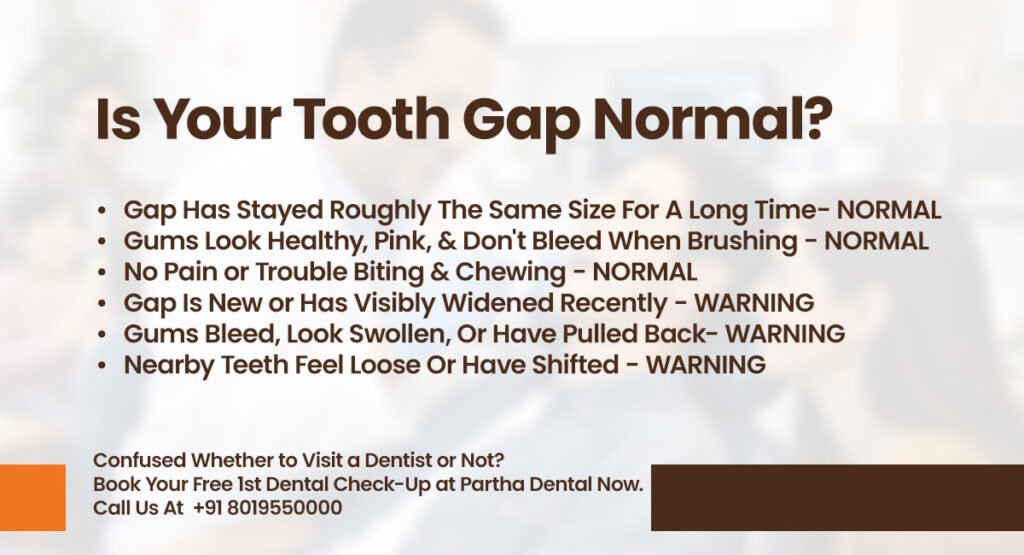
Normal, not urgent:
- The gap has stayed roughly the same size for months or years
- Gums look healthy and pink, and don’t bleed during brushing
- You feel no pain or difficulty biting and chewing
Worth a dental check:
- The gap is new, or it’s visibly gotten wider recently
- Gums bleed, look swollen, or have pulled away from the teeth
- Nearby teeth feel loose or have shifted, which can signal gum disease moving toward tooth loss if you leave it untreated
The best dental clinic in Bannerghatta Road starts every diastema visit with this exact check. It decides which treatment path applies before anything else.

How Is Diastema Treated?
Treatment follows the cause. A frenum-caused gap doesn’t respond to the same fix as a gum-disease-caused gap, even though both can look identical.
Orthodontic Treatment (Braces or Clear Aligners)
- Braces or clear aligners shift the teeth to gradually close the gap
- Treatment takes 6 to 24 months, depending on gap size
- Dentists often recommend this route for larger gaps or extra alignment issues
- Dental braces for crowded teeth explains more about how this treatment works
Cosmetic Treatment (Bonding or Veneers)
- Dental bonding: a dentist shapes tooth-coloured resin to close the gap in one visit
- Veneers: thin custom shells cover the front of the tooth, closing the gap and reshaping it
- Both work faster than orthodontic treatment
- Neither fixes a frenum or gum disease if either one caused the gap
Frenectomy
- A frenectomy releases or repositions an oversized or low frenum
- Dentists use this when bonding or braces alone can’t hold the gap closed
- Many patients get this with orthodontic treatment or bonding, not as a standalone fix
Periodontal Treatment
- Gum disease treatment treats the infection first, not the visible gap
- Most cases start with scaling and root planing, a deep cleaning below the gumline
- Advanced cases may need gum surgery
- Closing the gap before treating active infection doesn’t solve the real problem, and the gap can keep widening
The best dental clinic in Chennai sees all four paths regularly. The exam decides which one fits, not which treatment finishes fastest.
Does the Gap Come Back After Treatment?
Results often hold, but that word “often” carries real weight. Relapse risk ties to whether you treated the real cause, not just whether you closed the gap.
- An unreleased frenum keeps pulling, so it can reopen the same gap it created
- Ongoing habits like thumb-sucking keep applying the same pressure
- Skipping a retainer after orthodontic treatment lets teeth drift back toward their original spot
This last point has real research behind it, even outside diastema specifically. Orthodontic retention studies on relapse found something striking. A removable retainer alone comes with far higher relapse than a fixed, bonded one. In one trial, over half the patients using only a removable retainer saw relapse. Only a small fraction using a bonded wire did. That’s general retention research, not a diastema-only finding. It’s still a useful guide to what makes a closed gap stick.
Book a Consultation for Diastema Treatment With Partha Dental Now!
A gap between your teeth isn’t always something to fix. It isn’t always something to ignore either. The cause decides the right call, and only an exam can confirm it.
Partha Dental runs this same evaluation across 120+ clinics and 300+ doctors in South India. Dentists or orthodontists step in depending on what the exam finds. Dentists don’t recommend treatment before they find the real cause.
The best dental hospital in Chennai handles diastema cases tied to gum disease or needing surgical frenectomy. It also handles routine cosmetic visits.
Book a consultation at your nearest Partha Dental clinic, or call us at +91 8019550000 to schedule an appointment.
Frequently Asked Questions
Is Diastema a Sign of a Dental Problem?
Not usually. Most diastema causes reflect a normal developmental variation tied to genetics or frenum position. It’s worth checking if the gap is new, widening, or paired with bleeding or swollen gums. Those signs can point to gum disease instead of a simple size mismatch.
Can Diastema Close on Its Own in Children?
Often, yes, especially as baby teeth give way to permanent ones. Diastema tends to shrink as permanent teeth fully come in. Crowding tends to increase at that same stage instead. A gap that’s still there well after all adult teeth erupt is less likely to close without treatment. The best dental clinic in Bannerghatta Road monitors this during childhood check-ups. It doesn’t wait for a parent to raise it first.
Does the Cause Affect How Treatment Is Chosen?
Yes, directly. Diastema treatment depends on the cause, not just the gap size. A frenum-caused gap may need a frenectomy before or with cosmetic work. A gum-disease-caused gap needs periodontal treatment first. Treating the visible gap without fixing the real cause is the most common reason a “fixed” gap reopens.
Can Adults Get Diastema Treated at Any Age?
Yes. Tooth movement and cosmetic treatments both work on adult teeth. Spontaneous closure rarely happens in adults, unlike children, so treatment is the main way an adult gap closes. The best dental clinic in Chennai treats adult cases as often as childhood ones, with no upper age limit.
Will My Teeth Shift Back After the Gap Is Closed?
It depends on whether you treated the original cause and whether you used retention (like a retainer) afterward. A gap closed cosmetically while an untreated frenum or active gum disease remains has a real chance of reopening. The best dental hospital in Chennai schedules a retention check to catch this early. It doesn’t wait for the routine annual visit.
Does a Diastema Affect Speech or Chewing?
Usually not, for small gaps. Larger gaps sometimes affect how you pronounce certain sounds, since your tongue can pass through the space while speaking. Mention this to a dentist if it concerns you. It can factor into whether treatment makes sense for you.