










Most people who have a bite problem don’t come in asking about it. They come in for something else entirely. A jaw that clicks when they eat. Morning headaches that show up a few times a week.
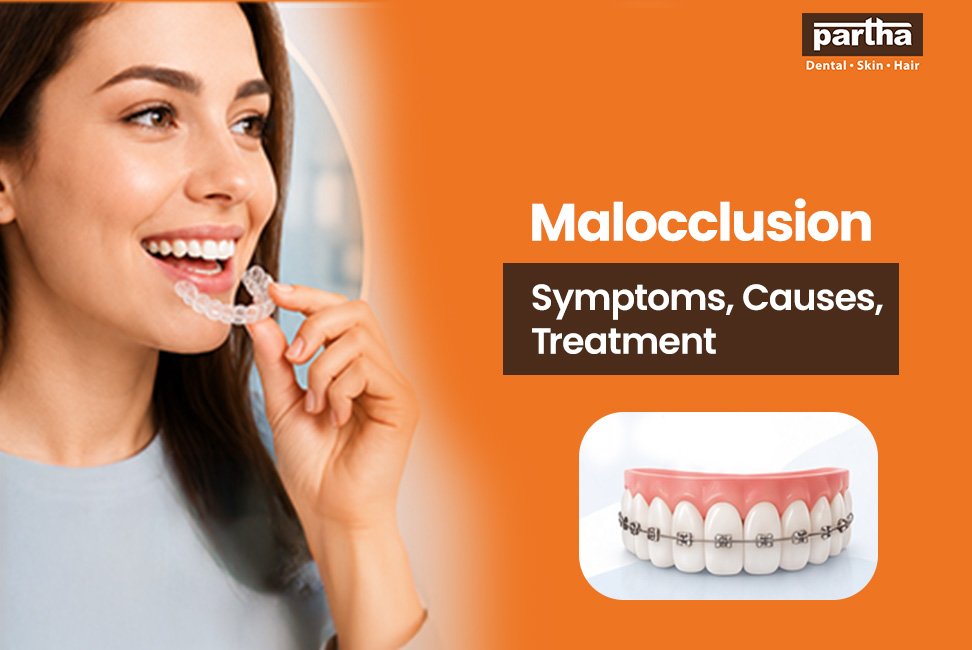
This can be malocclusion. It means the upper and lower teeth don’t meet correctly when the mouth closes. It’s one of the most common dental findings in India, and a significant number of people carry it for years without knowing what it is.
At Partha Dental, orthodontic specialists assess and treat bite problems across 120+ clinics in South India. This blog by our experts covers what malocclusion is, the signs that often get misread, and what treatment actually involves.
Your Bite And What It’s Supposed To Do
When everything is working correctly, the upper and lower teeth meet in a way that spreads chewing force evenly across the whole mouth. No single tooth takes more pressure than the others. The jaw opens and closes without strain. Cleaning between teeth is manageable because the teeth have reasonable space between them.
Malocclusion changes that balance. When teeth don’t meet correctly, certain teeth absorb more force than they should. The jaw muscles work harder to compensate. Over time, that imbalance creates problems that feel unrelated to the bite.
The Different Ways Malocclusion Shows Up In The Mouth
Malocclusion isn’t one thing. It describes several different bite patterns, each with its own set of consequences.
- An overbite is when the upper front teeth overlap too far over the lower front teeth vertically.
- An underbite is when the lower front teeth sit in front of the upper front teeth. It’s often driven by jaw size difference rather than tooth position alone.
- A crossbite is when one or more upper teeth sit inside the lower teeth instead of outside them. It can affect just the front teeth, just the back teeth, or both.
- An open bite is when the upper and lower front teeth don’t touch at all when the mouth is fully closed.
- Crowding is when there isn’t enough space in the jaw for the teeth to sit in their correct positions. Teeth overlap, rotate, or erupt at odd angles.
- Spacing is the opposite, where gaps exist between teeth because there are fewer teeth than the jaw has room for.
What Causes Malocclusion?
Malocclusion develops across a person’s life, not just in childhood. The starting point is often genetic. Jaw size and tooth size are largely inherited. A parent with a wide jaw and small teeth may pass on a jaw that has too much space. A parent with a narrow jaw and large teeth may pass on a jaw with not enough room. These inherited combinations explain why crowding or spacing often runs through families.
In childhood, certain habits and events shape how the bite develops.
- Mouth breathing changes the way the tongue rests and the way the palate develops.
- Prolonged thumb-sucking past age three pushes the upper front teeth forward over time.
- Losing a milk tooth too early without space maintenance lets neighbouring teeth drift into the gap, leaving no room for the permanent tooth when it arrives.
Adulthood brings its own malocclusion causes:
- A tooth that’s been missing for years and never replaced allows the teeth on either side to tilt toward the gap and the tooth above or below to over-erupt.
- Old dental work that sits slightly high changes how the bite closes.
- Teeth grinding, or bruxism, wears down surfaces unevenly and gradually shifts tooth positions.
Malocclusion Signs That Often Get Blamed On Something Else
Malocclusion rarely announces itself as a bite problem. It shows up as something else first.
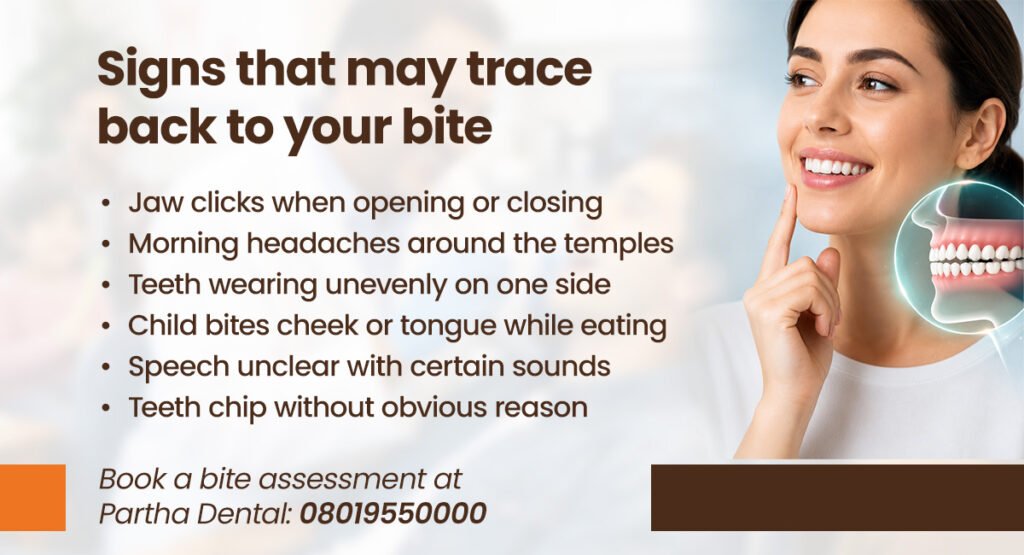
- A jaw that clicks or pops when opening and closing the mouth is one of the most common signs. Most people assume it’s just how their jaw works.
- Morning headaches, particularly across the temples or behind the eyes, are another malocclusion symptoms.
- Teeth that wear down faster on one side than the other, teeth that chip without obvious cause, or a front tooth that keeps cracking suggest uneven bite force distribution.
- Children who repeatedly bite their cheeks or tongue while eating.
- Speech that’s unclear with certain sounds, particularly the sounds that require the tongue to contact the teeth or palate.
A study published in BMC Oral Health, based on a systematic review and meta-analysis of Indian children aged 8 to 15, found malocclusion prevalence ranging from 12.5% to 33.3% in school-going populations. If two or more of these signs are familiar, the bite is worth checking at the best dental clinic in Bangalore.
When Malocclusion Needs Treatment And When It Doesn’t?
Not every case of malocclusion needs to be corrected. The dentist decides based on what the bite is actually doing, not just what it looks like.
- Mild malocclusion, where teeth are slightly crowded or a small gap exists but cleaning is manageable and there are no functional symptoms, is often monitored without treatment.
- Moderate malocclusion changes that equation. When crowding makes cleaning difficult enough to accelerate decay and gum disease, treatment has genuine functional value.
- Severe malocclusion, particularly when the jaw bones themselves don’t align correctly rather than just the teeth, affects chewing, speech, and in some cases breathing. Treatment here by the best dental clinic in Hyderabad is genuinely recommended, and earlier in life is easier.
What Malocclusion Treatment At Partha Dental Actually Looks Like From The Patient’s Side?
The first appointment isn’t a treatment session. The dentist at Partha Dental examines the bite visually, takes an OPG, which is a full-mouth panoramic X-ray, and sometimes takes a digital bite impression to understand how the teeth are meeting. That assessment determines which approach fits the case.
- For mild to moderate malocclusion, tooth braces are the most established approach. Braces can manage crowding, spacing, rotation, overbite, underbite, and crossbite with precision.
- Clear aligners are an alternative for patients where the bite correction falls within aligner capability. They’re removable, less visible than braces, and work well for moderate crowding, spacing, and mild bite problems.
- When the problem is skeletal, meaning the jaw bones themselves are misaligned braces or aligners alone won’t fully correct it. In these cases, corrective jaw surgery combined with orthodontic treatment is what the specialist evaluates.
After active malocclusion treatment, teeth have a tendency to drift back toward where they came from. The retainer is part of the treatment which holds the corrected position.
If your jaw clicks, your teeth feel like they’ve shifted, or your child’s bite hasn’t looked right for a while, the right move is a proper clinical assessment.
Those searching for the best dental hospital in HSR Layout can reach the Partha Dental branch directly or book a consultation at: 08019550000.
Frequently Asked Questions
My child keeps biting their cheek while eating. Is that a sign of malocclusion?
It can be. When teeth aren’t positioned correctly, soft tissue can end up in the path of the bite. A quick dental check will tell you properly.
Can malocclusion be treated in adults or only in children?
Adults are treated for malocclusion regularly. The jaw responds faster in children because it’s still developing, which makes treatment quicker. In adults, treatment takes longer but works.
Can clear aligners fix malocclusion or do I need braces?
It depends on what type and how severe. Clear aligners work well for mild to moderate crowding, spacing, and some bite corrections. The dentist assesses which option suits the specific bite pattern.