












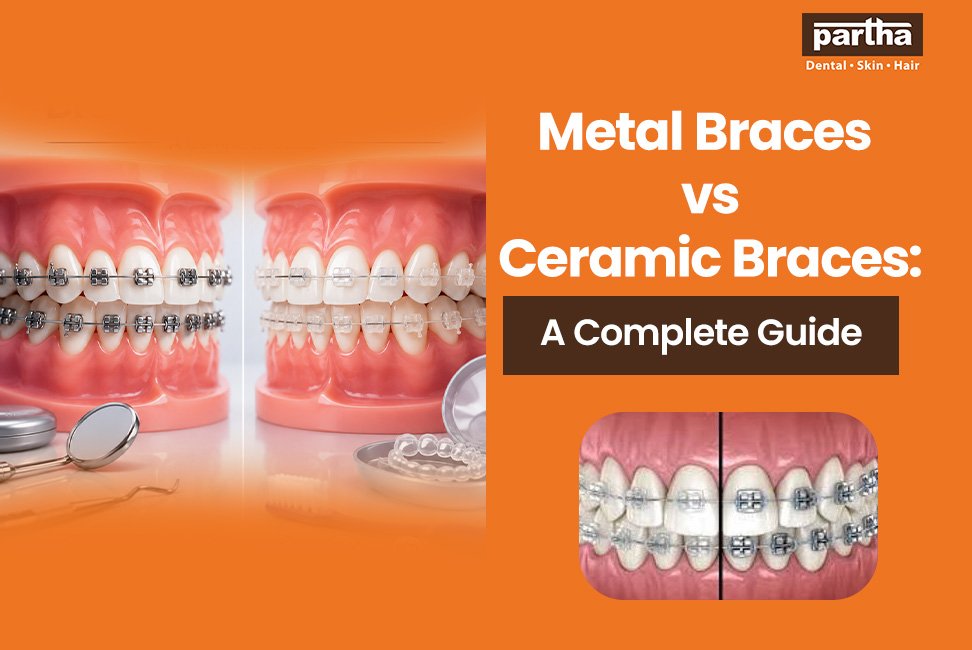
Both braces types straighten teeth the same way. Both use the same wire. Both need the same number of adjustment visits. So why does the choice feel so complicated?
Because one material difference changes four things that matter in daily life: how visible the braces are, what they cost, how they hold up, and what stains. This guide covers all four differences clearly.
The orthodontic specialists at Partha Dental, help patients choose between metal braces vs ceramic braces based on case needs, lifestyle, and budget across 120+ clinics in South India.
How Metal Braces Vs Ceramic Braces Actually Work?
Both braces types work on the same mechanical principle. A bracket is bonded to each tooth. A thin archwire runs through every bracket. And at each adjustment visit, the orthodontist tightens or changes the wire, applying gentle consistent pressure that moves teeth gradually into position. The only difference is the bracket material.
- Metal brackets are made from stainless steel.
- Ceramic brackets are made from tooth-coloured or translucent ceramic composite.
How Metal And Ceramic Braces Actually Look Like In Real Life?
Ceramic brackets are tooth-coloured and blend with the enamel. From a normal conversation distance, they’re far less noticeable than metal. Metal brackets are clearly visible. Silver against teeth in every angle. This is where the decision starts for most patients, so it’s worth being honest about what “less visible” actually means.
But ceramic braces even from the best dental clinic in Hyderabad are not invisible. The archwire running through the brackets is still metal in most cases. It’s thin, but it shows on close inspection.
The Staining Problem Most Indian Patients Aren’t Told About:
Standard ceramic brackets don’t stain. The elastic ligature ties do. These small elastic bands hold the wire into the bracket, and they absorb colour quickly. Chai. Coffee. Turmeric dal. Rasam. Tamarind. These are daily foods that turn fresh white ligature ties noticeably yellow within two to three days.
The brackets themselves stay clear. The ties don’t. Self-ligating ceramic brackets from the best dental hospital in Vijayawada eliminate this problem because there are no elastic ties.
Ceramic Vs Metal Braces Price : What You Actually Pay In India?
The price difference between metal and ceramic braces in India is consistent across cities. Ceramic brackets cost more to manufacture, and that cost is passed on.
| Type | India-wide range | Hyderabad range |
| Metal braces | ₹20,000 – ₹50,000 | ₹20,000 – ₹45,000 |
| Ceramic braces | ₹30,000 – ₹80,000 | ₹30,000 – ₹65,000 |
These are approximate ceramic vs metal braces price ranges based on current market data. Your final cost depends on four things:
- Case complexity. Severe crowding or significant bite correction takes longer. Longer treatment means more adjustment visits.
- Treatment duration. An 18-month case costs less overall than a 24-month case regardless of bracket type.
- Bracket brand. Premium ceramic bracket brands cost more than standard ones. Self-ligating ceramic brackets cost more than standard ceramic.
- Whether preparatory treatment is needed. Extractions, gum treatment, or restorative work before braces adds to the total.
Which Type Works Better For Your Specific Case?
For mild to moderate alignment issues, including crowding, spacing, rotation, and most bite corrections, both braces types work equally well. Treatment duration at the best dental clinic in Hyderabad is broadly similar: 12 to 24 months depending on case complexity.
There are two situations where metal brackets have a genuine clinical advantage.
- First, complex cases. Metal brackets generate less friction on the archwire.
- Second, children and younger teenagers. Ceramic brackets are more brittle than metal. A child who bites hard food, pencils, or sports equipment risks cracking a ceramic bracket.
The table below summarises where each type has the edge:
| Factor | Metal braces | Ceramic braces |
| Visibility | High, silver brackets visible | Low, blends with tooth colour |
| Cost | Lower | 30–50% higher |
| Durability | Higher, stainless steel | Lower, more brittle |
| Friction on wire | Lower | Slightly higher (standard) |
| Staining risk | None | Ligature ties stain (standard ceramic) |
| Complex case suitability | Strong | Suitable for mild-moderate |
| Child/teen suitability | Better | Less suitable under 14 |
| Self-ligating option | Available | Available — reduces staining |
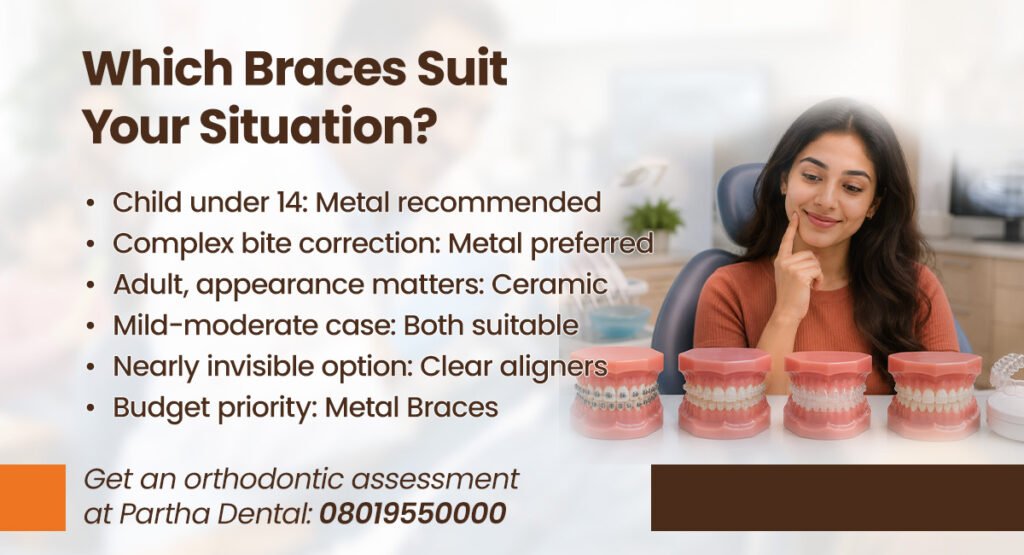
If an orthodontist recommends metal for your case, there’s usually a specific clinical reason behind it. Here’s a framework, to follow:
Choose metal braces if:
- You’re under 14, or choosing for a child
- Your case is clinically complex with significant bite correction needed
- Your orthodontist has specifically recommended metal for your case
- Budget is the primary consideration
- You eat a heavily pigmented diet and aren’t interested in managing staining
- You want the option of coloured ligatures, which teenagers often prefer
Choose ceramic braces if:
- You’re an adult in a professional, client-facing, or social-media-visible role
- Appearance discretion matters significantly in your daily life
- Your case is mild to moderate
- You’re committed to cleaning discipline and dietary awareness
- You can manage the additional cost
- You’re interested in self-ligating brackets that eliminate the staining problem
Neither Feels Right? Get Orthodontic Consultation At Partha Dental.
If you’ve decided you want braces but aren’t sure which type suits your case, the only way to get a real answer is a clinical assessment at a dental clinic in Whitefield.
Partha Dental rated 4.9/5 on google, 3 lakh + happy reviews and 120+ clinics across four major states: Telangana, Andhra Pradesh, Karnataka, and Tamil Nadu assess your bite, explain your options, and give you a treatment plan before you commit to anything. Book a consultation at your nearest clinic, call: 08019550000
Frequently Asked Questions
Can ceramic braces stain? I drink chai and coffee every day.
The ceramic bracket itself doesn’t stain. The elastic ties around the bracket do, and they pick up colour fast from chai, coffee, and turmeric.
My orthodontist recommended metal but I want ceramic. What should I ask?
Ask why metal was recommended for your specific case. Is it case complexity, age, or a clinical preference? If the reason is complexity or bite severity, there’s a real clinical basis for it.
Do ceramic braces take longer than metal braces?
For most cases, no. Treatment duration is broadly the same: 12 to 24 months. In complex cases requiring significant tooth movement, metal brackets generate slightly less wire friction, which may offer a marginal efficiency advantage.
Can I switch from metal to ceramic braces halfway through treatment?
It’s possible but not always practical. Switching means removing existing braces, which carries a small enamel risk, and rebonding new ones. It also adds cost. Discuss with your orthodontist before deciding.