












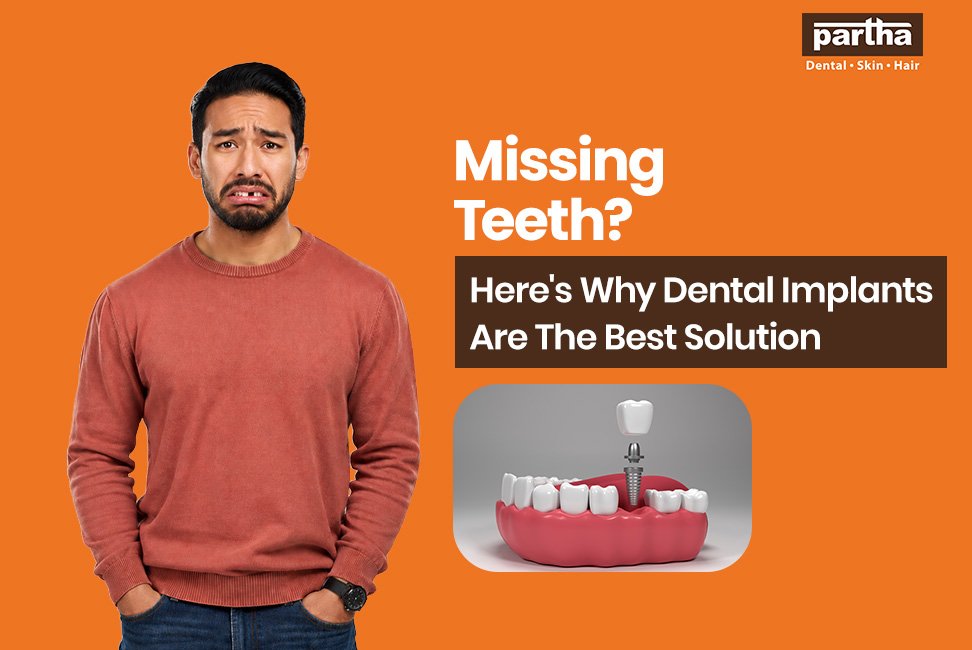
Dental implants solve the problem of missing teeth by replacing the missing tooth root, support the crown and help protect jawbone strength. They make chewing simpler, change speech and give better confidence. Many people compare bridges and dentures first because they want a quick fix, but they miss the long-term bone problem.
At Partha Dental, our implant specialists use 3D planning, guided surgery and personalised treatment plans for stable tooth replacement. With 120+ clinics across 4 states and advanced implant care in Hyderabad, our team helps you choose a solution that fits your mouth and lifestyle.
This guide is written by an expert dentist from Partha Dental to help you understand why implants stand out. Read further before you decide your tooth replacement option.
Why Dental Implants Outperform Every Other Tooth Replacement Option?
The direct answer to “Why are dental implants the best solution for missing teeth?” is simple. Implants offer a fixed solution that looks, feels and works closer to a natural tooth than removable dentures or tooth-supported bridges.
Dental implants stand out because they:
- Replace the missing tooth root.
- Help prevent jawbone shrinkage.
- Support a natural-looking crown.
- Do not depend on nearby healthy teeth.
- Last 10 to 30 years or longer with proper care.
- Stay stable while eating and speaking.
Dentures rest on the gums. Bridges use nearby teeth for support. Implants work from the jawbone upward, which makes them stronger for long-term tooth replacement.

The Bone Loss Problem That Only Implants Can Solve
A missing tooth can slowly reduce jawbone strength because the bone no longer gets pressure from chewing. Implants help solve this because they act like tooth roots and stimulate the bone.
What Happens To Your Jawbone When Teeth Go Missing?
Your jawbone needs regular chewing pressure to maintain its shape and density. Once a tooth goes missing, that area stops receiving root stimulation. The body then starts absorbing the unused bone.
After tooth loss, the jawbone may lose nearly 25% of its width in the first year. Bone shrinkage can continue by about 0.5 mm every year after that. This can change your facial support over time and make nearby teeth shift.
Patients who want the best dental implants in Hyderabad need a proper bone check first because implant success depends on bone strength, bone width and gum health.
How Implants Act Like Natural Tooth Roots To Preserve Bone?
A dental implant works like an artificial tooth root. The titanium post sits inside the jawbone and carries chewing force into the bone during meals.
This pressure can reach around 80 to 100 pounds per square inch during normal chewing. That force tells the bone to stay active. The bone then remodels around the implant and keeps the area stronger.
Bridges and dentures do not give this root-level stimulation. They fill the gap above the gum but do not directly protect the bone underneath.
Implants Vs Bridges Vs Dentures: The Honest Comparison
Implants offer the strongest long-term value because they preserve bone, avoid damage to nearby teeth and stay fixed during daily life.
| Feature | Implants Vs Bridges Vs Dentures |
| Lifespan | Implants can last 30+ years. Bridges last 10 to 15 years. Dentures last 5 to 7 years. |
| Bone support | Implants stimulate the jawbone. Bridges and dentures do not. |
| Nearby teeth | Implants do not need support from healthy teeth. Bridges require trimming nearby teeth. |
| Stability | Implants stay fixed. Dentures may slip while eating or speaking. |
| Maintenance | Implants need brushing, flossing and checkups. Dentures need removal, soaking and cleaning. |
| Comfort | Implants feel closer to natural teeth. Dentures may take longer to adjust. |
The Permanent Solution: Why Implants Last Decades?
Dental implants last for decades because the titanium post fuses with the jawbone through a process called osseointegration. This takes 3 to 6 months.
Once the implant bonds with the bone, it becomes a strong base for the crown. The implant fixture can last 30 years or longer with proper care. The crown on top may need replacement after 15 to 20 years because it handles daily chewing force.
Implants also show strong success rates. Many clinical reports place implant success at around 95% to 98% after 10 years in suitable patients. Good bone support, healthy gums and regular dental checkups improve that success further.
Why Are Implants Easy To Maintain?
Dental implants are easy to maintain because you clean them much like natural teeth. They do not need removal, soaking solutions or adhesives.
Daily implant care includes:
- Brush twice daily with a soft toothbrush.
- Floss around the implant crown once daily.
- Use an interdental brush if your dentist advises it.
- Visit the dentist every 6 months.
- Keep gums healthy to prevent infection.
- Avoid chewing very hard items on the implant crown.
Implants cannot get cavities because titanium does not decay. But the gum around an implant can still get infected. That is why gum care matters even after the tooth replacement looks complete.
If you visit a dental clinic in Kondapur, ask for implant maintenance guidance along with your checkup. Good care keeps the implant stable for longer.
When Implants Are Not The Best Choice?
Implants work well for many patients, but they may not suit every case right away. A dentist must check your health, bone, gums and healing ability first.
Implants may need extra planning when:
- Severe bone loss requires bone grafting first.
- Uncontrolled diabetes affects healing.
- Heavy smoking raises implant failure risk.
- Gum disease remains active.
- The patient cannot wait 3 to 6 months for healing.
- Budget limits make dentures a short-term option.
- Multiple missing teeth need staged treatment.
Heavy smoking can raise implant failure risk by nearly 50% in some patients. This does not always rule out implants, but it does mean we need strict planning, gum care and honest counselling before surgery.
Get The Best Dental Implants At Partha Dental, Hyderabad
Missing teeth can affect chewing, speech, confidence and jawbone strength. At Partha Dental, we help you replace missing teeth with implant planning, 3D scans, guided surgery, crown placement and follow-up care. Our implant team focuses on bone support, gum health, stable bite and natural-looking crowns. We also offer multi-location access, advanced technology and payment support so treatment feels easier to plan.
With experience across implant dentistry and full-mouth rehabilitation, we help you choose the right solution. Struggling with missing teeth? Get stable dental implants at Partha Dental. Call 801 955 0000 or WhatsApp 942 942 2020 today.
FAQs
Can I get an implant years after losing a tooth?
Yes, you can. Your dentist will first check bone levels because long gaps after tooth loss may need extra planning.
Do dental implants feel like real teeth while chewing?
Yes, implants feel close to natural teeth once they heal. You can chew better because the implant stays fixed in the jawbone.
Can one implant replace more than one missing tooth?
Yes, in some cases. Your dentist may use implants to support a bridge when several teeth are missing.
Will people know I have a dental implant?
Usually no. A well-planned implant crown matches nearby teeth in shape, size, and shade.
How soon can I smile after implant treatment?
You can smile soon after treatment, but the final crown comes after healing. Your dentist may suggest a temporary tooth in visible areas.