












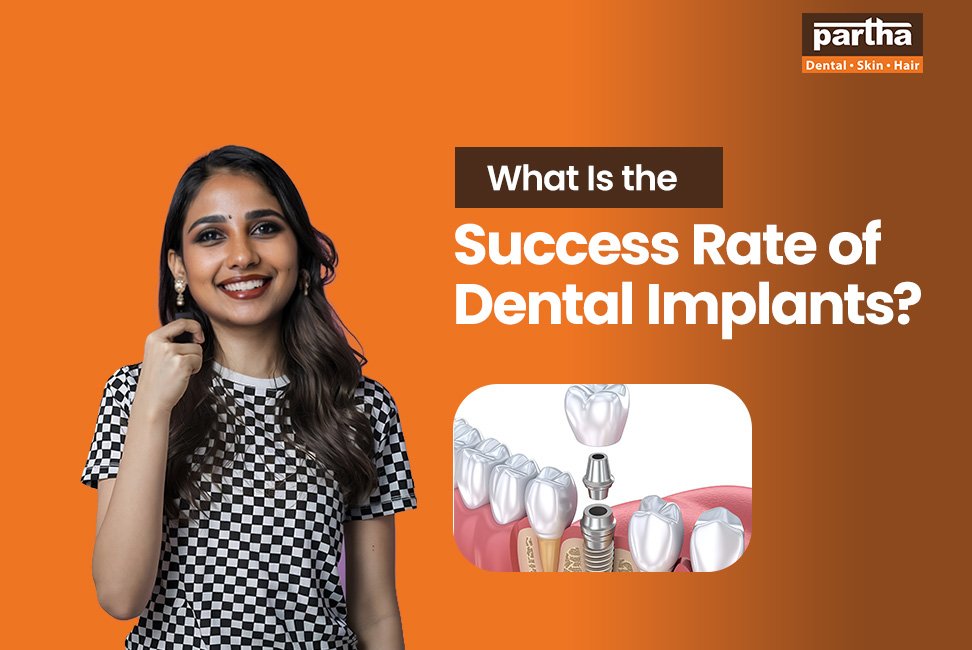
Missing teeth can make you worry about much more than appearance. You stress over chewing, bone loss, speech and if implant treatment will actually work for you. That is why this question matters so much. We understand that people do not want a vague promise. They want a realistic success rate, a clear idea of what affects it and a reliable clinic that plans treatment properly.
The good news is that dental implants have a very high success rate. Most long-term studies place the success rate of dental implants at about 95% to 97% over 10 years, with many implants lasting 10 to 30 years and some lasting a lifetime with proper care. What matters most is bone support, healing, oral hygiene and treatment planning.
Partha Dental brings strong proof to this decision. The brand reports a 98%+ implant success rate, 4 lakh+ implant procedures and 27+ years of implant expertise. This guide is written by an expert dentist from Partha Dental. Read on to understand what those numbers really mean for you.
What Is The Success Rate Of Dental Implants?
Dental implants are one of the most successful long-term tooth replacement treatments in dentistry.
Most studies report a 10-year implant success rate of about 92.5% to 97%. Long-term survival data also remains strong, with about 86% to 89.8% at 15 years and roughly 75% to 89.8% at 20 years. That is why implants are considered a reliable option for replacing missing teeth when the case is selected and planned well.
| Time Period | Reported Outcome |
| 10 years | 92.5% to 97% success |
| 15 years | 86% to 89.8% survival |
| 20 years | 75% to 89.8% survival |
These numbers reflect both healing and long-term function. They also show that implant treatment is not just about placing a titanium post. It depends on stable osseointegration, healthy gums, good bone density and proper maintenance over time.
Does A High Implant Success Rate Work The Same For Everyone?
No. A high average success rate does not mean every patient carries the same chance of success.
An ideal patient with healthy gums, good jawbone support and no smoking habit falls near the 95% to 98% range. A patient with poor bone quality, uncontrolled diabetes, heavy smoking or bruxism may fall lower. In smokers, many reports place success closer to 85% to 90%. Smoking can also raise implant failure risk by around 10% to 15% or more compared with non-smokers.
Uncontrolled diabetes, especially when HbA1c is above 7%, can reduce healing quality and increase infection risk. Bone loss can reduce initial stability and may require grafting before placement. Surgeon experience also matters. Some research suggests operators with fewer than 100 implant cases may show lower success, around 80%, than experienced implant specialists.
So when people compare the best dental implants in Hyderabad or look for multi-city implant care, they should not ask only, “What is the success rate?” They should ask, “What is my success rate likely to be in my current condition?”
What Factors Affect The Success Rate Of Dental Implants The Most?
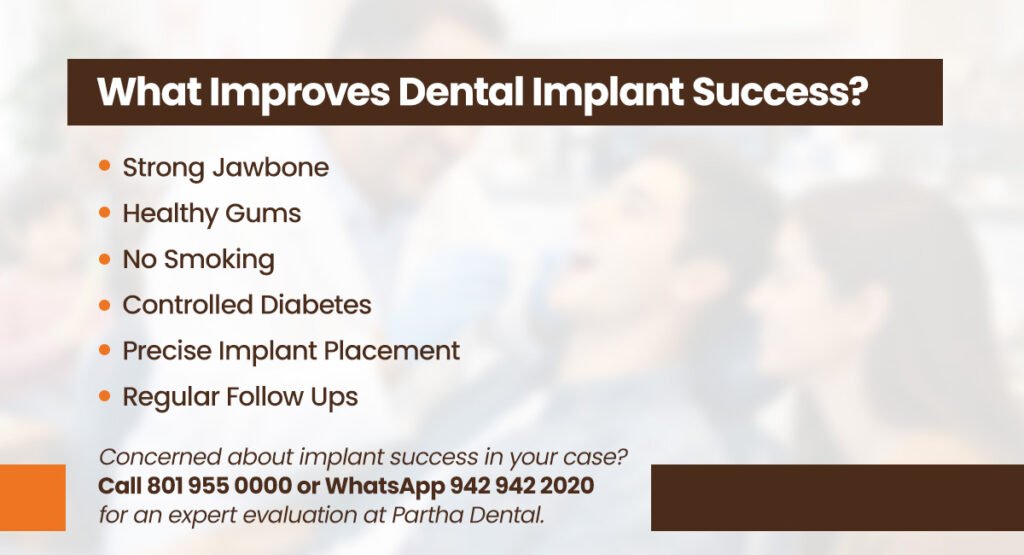
The biggest factors are bone, healing, hygiene, bite forces and clinical planning.
If the implant does not integrate well with the jawbone, the case can fail early. If bacteria collect around the implant after treatment, the case can fail later. If the bite places too much force on the implant, the surrounding bone and restoration can also suffer.
The most important factors are:
- Smoking: Reduces blood flow and slows healing.
- Bone Quality and Quantity: Weak or thin bone lowers primary stability.
- Oral Hygiene: Poor cleaning raises the risk of peri-implantitis.
- General Health: Diabetes, osteoporosis and immune issues can affect healing.
- Bruxism: Grinding and clenching can cause overload.
- Provider Expertise: Precise placement improves implant stability and long-term performance.
- Periodontal History: Previous gum disease can increase future infection risk.
Which Risk Factors Can Lower Implant Success?
Some risks deserve special attention because they repeatedly appear in long-term implant failure research.
These include:
- Uncontrolled diabetes
- Poor oral hygiene
- Insufficient jawbone
- History of periodontal disease
- Occlusal overloading
- Radiation therapy in the jaw area
- Certain medications, including bisphosphonates, NSAIDs and immunosuppressants
- Surgical complications, such as poor primary stabilization or excess heat during drilling
Why Do Some Dental Implants Fail Early Or Later On?
Implants fail for different reasons depending on when the problem happens.
Early failure happens within the first few months, before the implant settles firmly into the jawbone. The most common cause is failed osseointegration. This can happen because of infection, poor bone quality, surgical trauma, excess heat during placement or premature loading before healing is complete.
Late failure happens after the implant has already been restored and used in function. The most common cause is peri-implantitis, which is a bacterial infection that damages the gum and bone around the implant. Other late causes include overload from grinding, poor bite alignment, smoking and poor oral hygiene.
What Is The Difference Between Early Failure And Late Failure?
| Point Of Difference | Early Failure | Late Failure |
| Usual timing | Within 3 to 4 months | After loading, after 1 year or more |
| Main cause | Failed osseointegration, infection, surgical trauma | Peri-implantitis, overload, poor maintenance |
| Bone loss | minimal or localized | moderate to severe |
This distinction matters because early failure points to healing or surgical issues, while late failure points to maintenance, infection control or force management.
How Long Do Dental Implants Last With Proper Care?
Dental implants are designed as a long-term solution. In many cases, the implant post lasts for life once it heals well and remains infection-free.
The visible crown does not always last as long as the implant itself. Most implant crowns last about 10 to 25 years before wear, bite stress or surface damage may require replacement. That is why people should think of an implant as two parts: the titanium implant inside the bone and the crown above the gum.
Studies commonly show that around 90% to 95% of implants remain successful beyond 10 years. With strong oral hygiene, regular checkups and no smoking, long-term outcomes remain excellent. If you are exploring best dental implants in Chennai or implant consultations in other major cities should understand that durability depends as much on care as on surgery.
How Can You Improve Your Chances Of Long Term Implant Success?
You must brush twice daily with a soft toothbrush i you have dental implants. Clean around the implant with floss, implant floss or interdental brushes. Use a water flosser if the area is hard to reach. Attend dental checkups every 6 months so bone levels, gum health and implant stability can be monitored before problems grow.
Lifestyle also matters. Stop smoking if possible. Control diabetes carefully. Avoid biting very hard objects like ice and hard candy. If you grind your teeth, wear a nightguard to reduce constant pressure on the implant and crown. During early healing, follow food and hygiene instructions closely.
These habits reduce infection risk, improve long-term gum support and help implants function for 20+ years.
How CBCT Scans And Guided Surgery Increase Implant Treatment Success?
CBCT scans and guided surgery improve implant treatment because they replace your fear and doubt with precise 3D planning.
A CBCT scan shows the exact height, width and density of the jawbone. It also maps critical structures like the inferior alveolar nerve and the sinus floor. That helps the dentist place the implant in the safest and most stable position. It also helps identify if grafting or a different drilling protocol may be needed.
Guided surgery takes that digital plan and transforms it accurately into the mouth through a surgical guide. This controls angulation, depth and implant position more precisely than free-hand placement. Some reports show that if you, in a CBCT-planned group received implant placement successfully, while 2D-only planning led to aborted surgeries in some cases.
That is why patients comparing dental implants in Bangalore or other cities should ask if the clinic uses CBCT-based planning and guided implant placement instead of relying only on conventional imaging.
Choose Partha Dental For a Successful Implant Treatment!
Partha Dental supports implant patients with strengths that matter after the decision to start treatment. The network includes 120+ clinics across South India, 300+ expert doctors and 15 lakh+ happy patients! This gives you easier access to consultation, diagnosis, implant placement, restoration and follow up care. You can also benefit from digital planning support and continuity across multiple cities, including best dental implants in Vijayawada and other key locations.
Missing teeth can affect chewing, confidence and daily comfort. Get the right implant solution at Partha Dental. Call 801 955 0000 today.
FAQs
Can age alone make someone unsuitable for dental implants?
No, age alone does not rule out implants. Overall health, bone condition and healing ability matter much more than the number of birthdays.
Do dental implants feel different from natural teeth while chewing?
Most people say implants feel very close to natural teeth once healing is complete. They feel much more stable than removable options.
Can one failed implant be replaced later?
Yes, in many cases a failed implant can be replaced after proper healing and reassessment. The dentist first checks bone support, infection control and the reason for failure.
Are implant materials important when choosing treatment?
Yes, they can be. Implant design, surface quality and component fit can influence healing, stability and long-term performance.
Will I need special cleaning products forever after getting an implant?
Not always, but the right tools help a lot. Many patients do well with a soft brush, floss aids and interdental cleaners recommended by their dentist.