












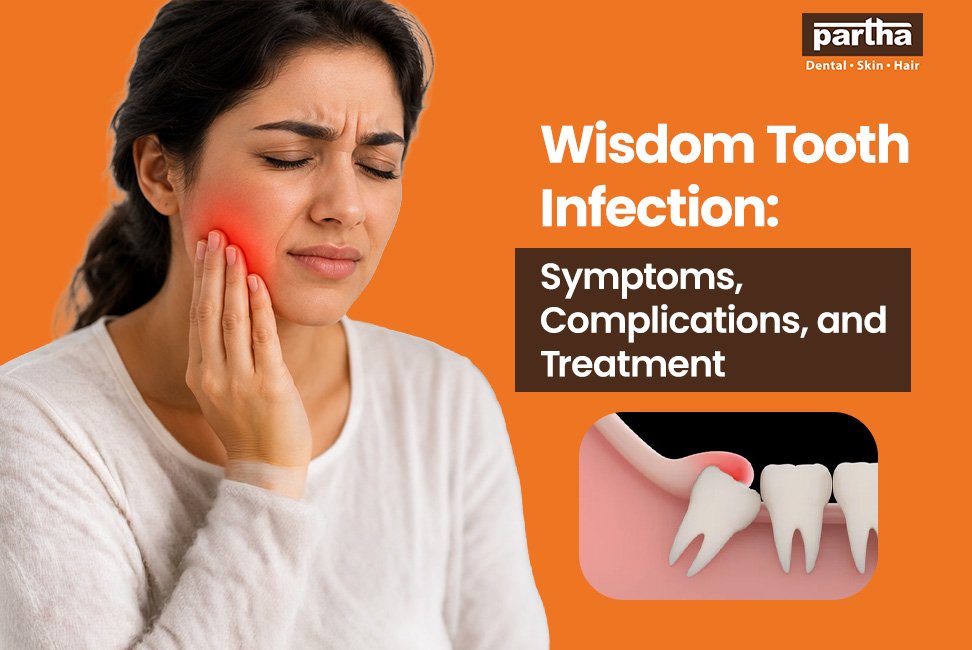
The pain at the back of the mouth when chewing is easy to dismiss. It feels like something that should settle overnight, and occasionally it does. What patients don’t expect is it recurring a few weeks later.
That pattern has a cause. A wisdom tooth when partially breaks through the gum, it leaves a narrow gap between the tooth and the overlying gum tissue. Bacteria get in. Saliva and a toothbrush can’t reach them. The infection that follows is called pericoronitis, and it recurs until something changes about the tooth or the gum.
At Partha Dental 300+ doctors including oral surgery specialists assess and treat such wisdom tooth infections at every stage.
What Are The Symptoms Of A Wisdom Tooth Infection?
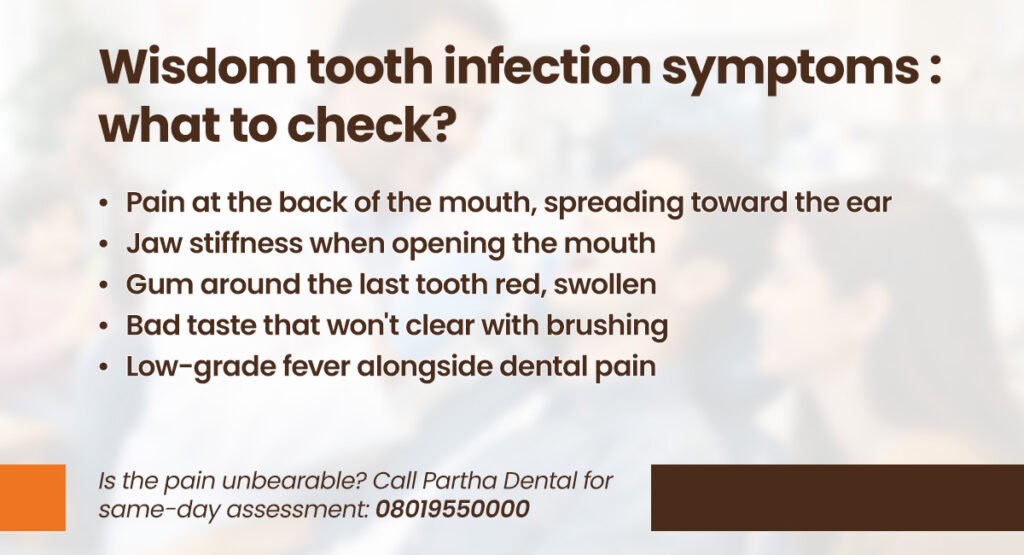
The first 24 to 72 hours are when most patients notice something is genuinely wrong rather than just uncomfortable. Pain that starts at the back of the mouth and spreads toward the ear or jaw is the most consistent early sign.
Some patients notice the jaw won’t open as wide as usual, this is called trismus, and it happens because the muscles around the jaw joint are responding to the nearby inflammation.
The gum flap over a partially erupted wisdom tooth, called the operculum, becomes red and tender. It bleeds easily when touched. Food traps underneath it.
A bad taste in the mouth that doesn’t clear with brushing is a specific sign of active infection. It indicates pus is present in the area.
The distinction patients often miss: Wisdom tooth pain doesn’t always mean active infection. Eruption pressure, food trapping under the gum flap, and gum irritation all cause similar pain without true bacterial infection.
The markers that point to actual infection are :
- Fever
- A persistent bad taste from pus,
- Swelling that doesn’t reduce within 48 hours.
If those three wisdom tooth infection symptoms are present, prompt dental assessment is necessary.
What Complications Can A Wisdom Tooth Infection Cause?
This is the section most patients need to read before deciding to wait another week. Wisdom tooth infections don’t plateau and stay manageable indefinitely. The wisdom tooth complications escalate in predictable stages.
Stage 1: Pericoronitis
Pericoronitis is the medical name for the infection and inflammation of the gum tissue surrounding a partially erupted wisdom tooth. At this stage the infection is localised. Antibiotics and professional cleaning of the area settle the acute episode. But the gum flap remains. And as long as it’s there, the bacterial trap is there.
Stage 2: Dental Abscess
When bacteria penetrate deeper, a collection of pus forms at the root tip or in the surrounding bone. The swelling becomes firmer and more visible. Pressure builds. Antibiotics can reduce the acute infection temporarily, but an established abscess often needs drainage alongside medication. The tooth itself may become non-restorable at this stage.
Stage 3: Cellulitis And Fascial Space Infection
At this stage the infection has spread beyond the tooth and bone into the soft tissue spaces of the face and neck. The swelling becomes externally visible, often across the cheek or under the jaw. Trismus worsens. Eating and swallowing become difficult. This stage frequently requires the best dental clinic in Chennai admission, intravenous antibiotics, and surgical drainage.
Stage 4: Ludwig’s Angina And Sepsis
Ludwig’s angina is a rapidly spreading infection of the floor of the mouth and the spaces around the throat. It’s rare but life-threatening. The swelling can compress the airway. Sepsis, infection entering the bloodstream is the most serious outcome, carrying a significant mortality risk if not treated in a hospital setting immediately.
Most wisdom tooth infections don’t reach Stage 3 or 4. The patients who do are almost always the ones who delayed treatment for weeks, used antibiotics without addressing the source, or dismissed early symptoms.
Does A Wisdom Tooth Infection Go Away On Its Own?
The pain sometimes settles. The cause doesn’t. Pericoronitis can calm down between episodes, particularly if the patient rinses carefully and avoids irritating the area. But the gum flap that allowed the infection in the first place is still there.
Antibiotics manage active infection but don’t remove the flap or the tooth. Every course of antibiotics treats the symptom while leaving the source intact.
Repeated antibiotic use without definitive treatment also carries its own clinical concerns, including antibiotic resistance developing in the oral bacterial population.
How Is A Wisdom Tooth Infection Treated At Partha Dental?
Wisdom tooth treatment at the best dental clinic in Hyderabad follows a clear sequence. The stage of the infection determines where it starts.
Step 1: Assessment
An OPG, which is a full-mouth panoramic X-ray, shows the wisdom tooth’s position, depth, angle, and relationship to the inferior alveolar nerve. This determines what treatment options exist.
Step 2: Immediate management
If active infection is present, the dentist cleans the area around the tooth professionally, irrigating under the gum flap to remove bacteria and debris. Antibiotics are prescribed where clinically indicated. Pain and swelling are managed before definitive wisdom tooth treatment takes place.
Step 3: Definitive treatment
Two options exist depending on the tooth’s position and the patient’s history.
- Operculectomy is the removal of the gum flap covering the wisdom tooth. It’s appropriate when the tooth position is clinically acceptable and the problem is solely the tissue trap rather than the tooth itself. At Partha Dental, laser-assisted operculectomy is available at selected branches.
- Wisdom tooth extraction is the most common long-term solution for impacted, misaligned, or recurrently infected wisdom teeth. The tooth is removed under local anaesthesia. Most patients are back to normal eating within a few days, though some swelling and soreness are expected in the first 48 hours.
The choice between operculectomy and extraction depends on the OPG findings, the patient’s history of infection episodes, and the clinical judgement of the dentist or oral surgeon. Partha Dental specialists make this recommendation after assessment.
Don’t Wait for a Wisdom Tooth Infection to Escalate. Get Wisdom Tooth Care At Partha Dental
Pericoronitis that returns more than twice is rarely going to resolve without definitive treatment. The longer the cycle of infection and antibiotics continues, the higher the risk of progressing to the complications described above.
Partha Dental has performed wisdom tooth extractions across 120+ clinics in South India. The oral surgery team manages cases from eruption infections to complex impacted third molars requiring surgical extraction under local anaesthesia. Google reviews across Partha Dental branches consistently rate wisdom tooth extraction and post-operative care among the highest-satisfaction procedures in the network.
Searching for the best dental clinic in Jayanagar? Book a consultation at 08019550000.
Frequently Asked Questions
How do I know if my wisdom tooth pain is an infection or normal eruption discomfort?
Eruption discomfort is generally a dull pressure that comes and goes. Infection adds specific markers: a bad taste in the mouth from pus, swelling that doesn’t reduce after 48 hours, and fever alongside the dental pain.
Can I take antibiotics without going to the dentist?
Antibiotics reduce the acute infection temporarily but don’t address the source. The gum flap or impacted tooth that created the bacterial trap is still there after the course ends.
Will I definitely need the wisdom tooth removed?
Not always. If the tooth position is clinically acceptable and the infection is driven solely by the gum flap, operculectomy, which is removal of the flap only, may be sufficient. The dentist determines this after reviewing the OPG.
How long does wisdom tooth infection treatment take?
Immediate management with antibiotics and professional cleaning takes one appointment. Most patients are comfortable within 3 to 5 days of extraction. Full healing of the socket takes several weeks.