









If you’ve ever thought about how to re-establish implants in your upper jaw, let me introduce you to the blue collar worker of the implant world: The Pterygoid Implant.
This new treatment in Hyderabad and beyond, has given people who have been told that “upper jaw dental implants” are impossible, a new reason to smile – literally.
No more saying to yourself, “I can’t believe I am saying this, but I can’t get upper jaw dental implants because of bone loss or sinus issues.” Let’s jump in with some humor, but a lot of information.
1. What are Pterygoid Implants?
Think of the upper jaw as a house with a few storms. The back wall (your upper molar area) may have crumbled or not have any bone at all.
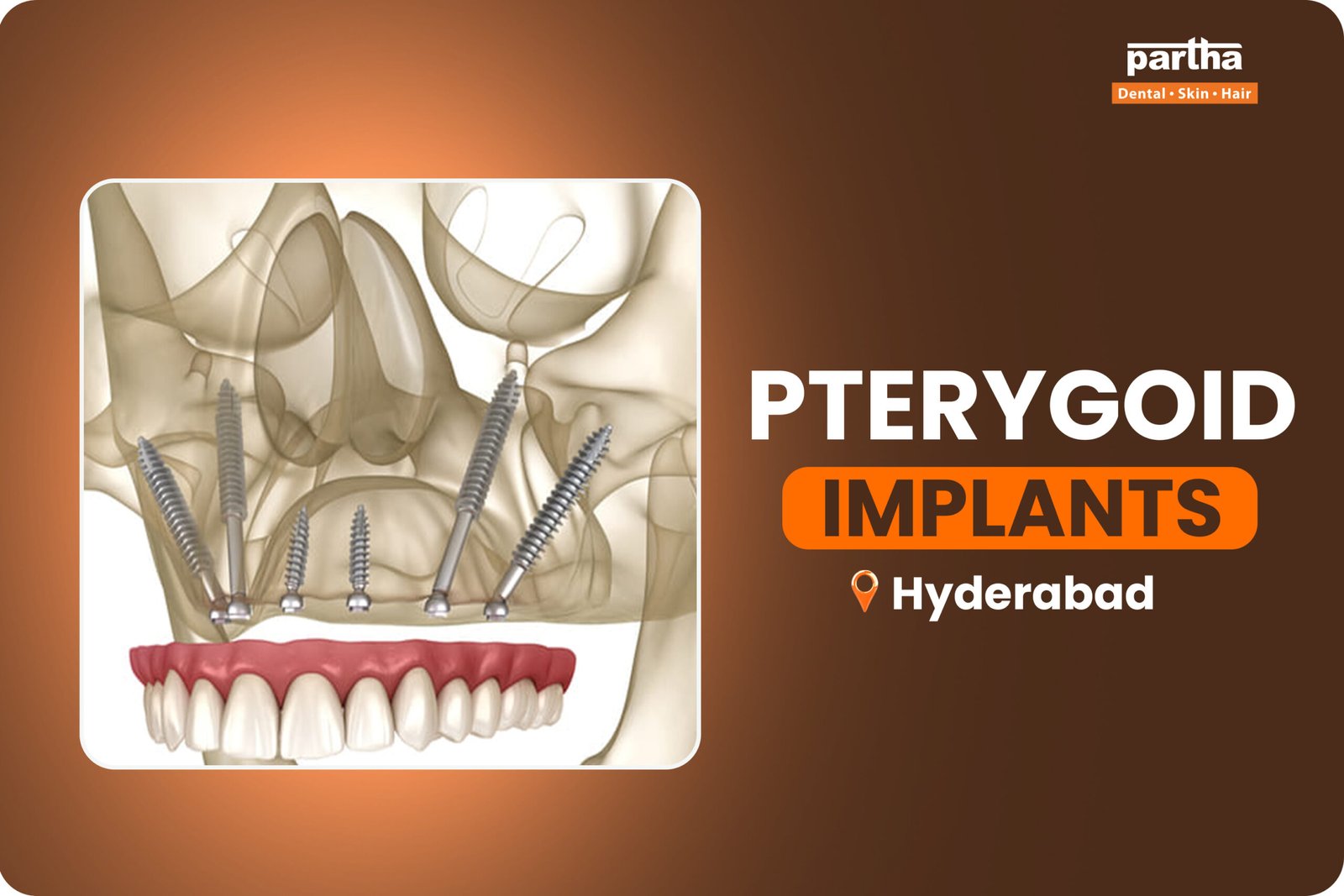
Usually, this means bad news for ordinary implants. Pterygoid Implants are different because they don’t anchor in the usual jaw bone, instead they anchor into a very strong bone behind your upper jaw.
We call that area the pterygoid plate, and it, along with the bone on the face, is a very dense bone.
With this treatment you do not need a bone graft, you do not need a sinus lift and you do not have to wait a few months for your jaw to “grow more bone.” Pterygoid implants tap into the dense bone at the back of your face and can provide you with firm, stable support of new teeth when you are not a candidate for ordinary implants.
In short, if you’ve lost bone in your upper jaw or someone told you that you’re “not a candidate for implants,” then Pterygoid Implants in Hyderabad could completely change that.
2. The Pterygoid Implant Procedure: From, “Oh No” to “Oh Wow!”
Let’s be real, in any instance involving the jaw sounds a little harsh. Though, the pterygoid implant procedure is actually clever and minimally invasive, performed by a skilled practitioner. Here’s the procedure.
Step 1 – Planning and Scanning
Before anyone touches a dental drill, there is careful planning involved. Your dentist will do 3D scans (CBCT) to precisely map out the bone structure and position of implants. Like your upper jaw is being mapped out in Google Maps. Specifically, precise.
Step 2 – Anaesthesia and Access
You will receive local anaesthesia (or even mild sedation) and once your mouth is numb, the dentist will make a small cut at the back of the upper jaw area and carefully drill at an angle, targeting the strong pterygoid bone right behind it!
That sounds like some dental gymnastics, but it is a perfectly calculated and precise move, avoiding the sinus and fragile aspects of your jaw.
Step 3 – Place and Fix the Tooth
The implant is long and angled to reach the pterygoid bone. After placing the implant, a temporary crown or bridge is usually affixed so you don’t need to worry about hiding your smile for months.
Step 4 – Heal and Integrate
The implant connects with your bone over the next few months, a process called osseointegration. Once well-connected, your final prosthetic (which is persistently a part of a full arch or bridge) will be placed. Then you can eat, smile, laugh with no worries of further movement of the dentures or worse, clicking.
3. Pterygoid Dental Implant Advantages
Now, let’s get to the good stuff—what is it about pterygoid dental implants that patients and dentists gravitate toward?
No bone grafting required: No waiting indefinitely for newer bone to grow, pterygoid implants avoid that process entirely.
Avoids any sinus issues: As the implants are placed behind the sinus, a sinus lift surgery is not necessary.
Instant restoration: In most instances, we can place fixed temporary teeth for patients in just days instead of a wait of months.
Strong and dependable foundation: The bone in the area of the pterygoids is dense and strong and provides the most formidable area of support for dental implants placed in the upper jaw.
Optimal for full arch dental implants: This area gives the greatest advantages when restoring a full upper arch and needing posteriors to support a more predictable size balance.
Stronger bite force: You will be eating again, as you did before you can even eat those tougher things you have avoided!
In a nutshell, it’s like going from a rickety wooden stool to a steel chair.
You sit, smile, and eat with confidence!
4. Pterygoid Implant Cost in Hyderabad
Ah, yes, everyone wants to know: “What is this going to cost me?”
The pterygoid implant cost in Hyderabad can vary based on multiple factors including the difficulty of your case, amount of pterygoid implants, and certain types of prosthesis. In general:
One pterygoid implant could cost approximately ₹30,000 to ₹45,000.
In a full mouth dental implant case consisting of multiple pterygoid implants and a full arch bridge, prices could be higher based on materials used and the clinical setting.
Extra costs can be incurred for 3D scans, sedation, and follow-up prosthetic fittings.
The bright side is that Hyderabad is the leader in providing world-class dental implants at a fraction of the cost in most Western countries.
We’re all about making pricing transparent at Partha Dental and we can work with you to create a plan that is both affordable and manageable for your oral comfort.
So you can smile wide without having to worry if the cost will sneak up on you like an uninvited cavity!
5. Long-Term Findings of Pterygoid Implants
If you’re thinking “This is way too good to be true”, here is the good news: published outcomes and literature suggest that pterygoid implants can have long-term success rates equivalent or exceeding conventional implants in the upper jaw especially with bone loss.
The implants should last decades with proper maintenance and follow up. It is all:
- Accurate planning- using imaging devices to guide placement.
- Suitable occlusal design- there is no unexpected load on implant(s).
- Proper hygiene- yes brushing and flossing must still happen!
- Regular hygienist appointments- to make sure everything is still great!
At Partha Dental, we have witnessed patients restore full chewing function, clear speech, and newfound confidence all without grafts or sinus lifts.
The stability of these implants makes them one of the most predictable and reliable long-term solutions for upper jaw dental implant patients.
Pterygoid Implants and Full Arch Dental Implants
Have you been told, “you can’t have implants because you don’t have enough bone?” Don’t despair. When we put together recreating pterygoid implants with front implants, (and in extreme cases we utilize zygomatic implants) we will be able to restore a full arch of teeth without any bone grafting.
For patients that desire full arch dental implants, this means:
- No removable dentures.
- No waiting months for grafts to heal.
- A fixed set of teeth that feel natural and function like your own.
In short, pterygoid implants are the secret weapon behind successful full mouth rehabilitations. They allow us to give you a complete, permanent smile without the long detours traditional methods require.
If you’ve been told that implants are not an option for you because of bone loss or sinus issues, Pterygoid Implants in Hyderabad could be your ideal choice. They provide strength and stability, as well as lasting comfort, with no complex bone grafting.
So, whether you’re yearning to destroy that next crunchy snack, or simply want to smile with confidence without worrying about it pterygoid implants can help with that.
Call us now 04041420000 to schedule a consultation with us at Partha Dental
6. FAQs
Not at all! They are performed under local anaesthesia (and sedation if needed). You won’t feel pain, although you might have a bit of pressure while they are being placed.
Depending on your case, temporary restorations can generally be attached in a few days after the implant is placed. Full healing typically takes a few months until we can attach the final set of restorations.
Yes, they are designed specifically for the posterior maxilla where you typically will have bone loss.
Anyone with missing teeth in the posterior maxillary area that is lacking bone, or has had previous implants fail would warrant consideration for pterygoid implants. Your dentist will confirm this after a diagnostic scan.
Yes! In fact, given they are anchored in dense bone the success rate is extremely high with proper hygiene maintenance.
Post-surgery follow-up care is essentially the same as you would for natural teeth: brushing two times a day, flossing or using an interdental brush and having regular checkups, all follows the guideline for best maintenance.
Yes, that’s actually how full arch rehabilitations work! Pterygoid implants provide the strong back support while other implants handle the front. Read more.
Dental Questions? We’re here to help!
Disclaimer:
The prices mentioned in this blog are indicative and may vary based on the severity of the condition, technology used, and materials suggested by the Dentist. They are accurate as of the date of publishing and subject to change as per clinic policy. Third-party or AI-generated estimates may not reflect actual clinic pricing. For accurate costs, please visit your nearest Partha Dental clinic.