










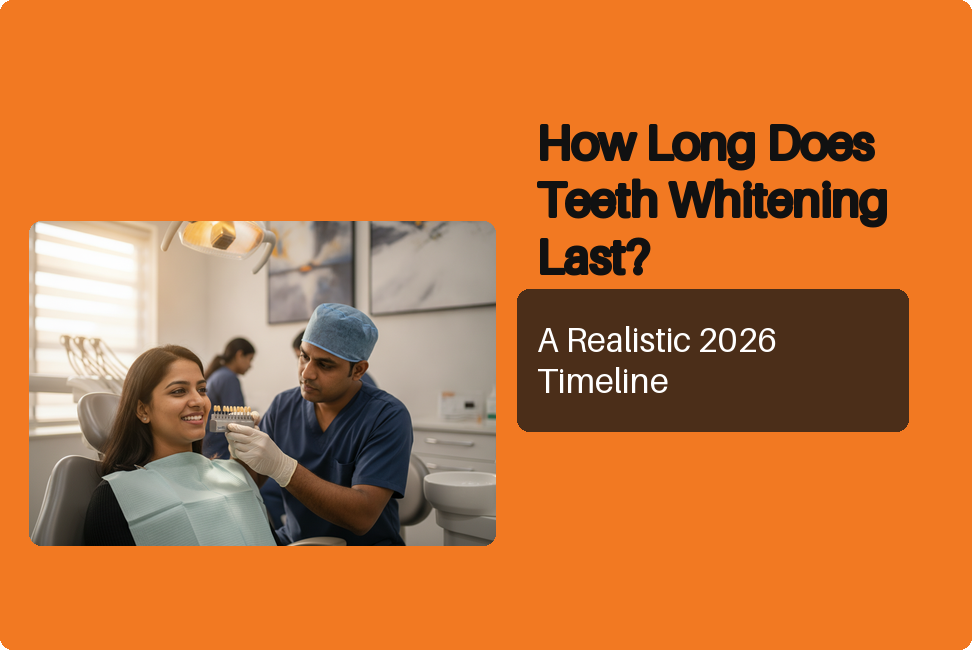
How long does teeth whitening last is the first question patients ask after seeing their brighter smile, because no one wants to invest time and money only to watch results fade in weeks. Professional in-office whitening typically lasts 1 to 3 years, while at-home kits maintain results for about 6 to 12 months, though your daily habits ultimately decide where you fall in that range. At Partha Dental, we have guided thousands of patients through whitening consultations, and we see the same pattern: people who understand the real timeline make better choices about which treatment to choose and how to protect their investment. This article breaks down exactly what determines how long your results will last, compares professional and at-home options with honest numbers, and shows you the specific habits that extend or shorten your whitening.
Key takeaways
- Professional whitening lasts 1 to 3 years, while at-home kits fade within 6 to 12 months.
- Coffee, tea, red wine, and tobacco are the fastest ways to restain whitened teeth.
- Touch-up treatments every 12 to 18 months help maintain professional results without full retreatment.
- Good oral hygiene and regular dental cleanings can extend whitening duration significantly.
- Not everyone is a candidate; crowns, veneers, and existing dental work do not whiten.
How long does teeth whitening last with professional treatment?
Professional in-office whitening typically lasts 1 to 3 years when you follow basic maintenance habits. This is the longest-lasting option available because dentists use higher-concentration bleaching agents that penetrate deeper into enamel, breaking up stains at the source rather than just surface discoloration. At Partha Dental, our Teeth Whitening protocols include protective gum barriers and controlled light activation to maximize results safely.
The 1-to-3-year range is not arbitrary. Patients who avoid heavy staining foods and drinks, do not smoke, and maintain regular cleanings often see results closer to the 3-year mark. Those who return to coffee habits immediately or skip dental visits may notice fading within 12 to 18 months. Your natural enamel thickness and original shade also matter; thinner enamel or deeper intrinsic stains may show faster recurrence.
Professional treatment is not permanent because enamel remains porous after whitening. New pigments from food and drink re-enter these pores over time. However, the deep cleaning effect means even gradual fading starts from a much brighter baseline than at-home alternatives provide.
How long does at-home teeth whitening last compared to professional?
At-home whitening kits, whether dentist-provided trays or over-the-counter strips, typically maintain results for 6 to 12 months. The lower concentration of active ingredients means less penetration into enamel, so the initial lift is more superficial and more vulnerable to restaining.
| Factor | Professional In-Office | At-Home Kits | Over-the-Counter Strips |
|---|---|---|---|
| Typical duration | 1 to 3 years | 6 to 12 months | 3 to 6 months |
| Active concentration | Higher, dentist-controlled | Moderate, custom trays | Lowest, one-size-fits-all |
| Speed of initial results | Immediate, 1 to 2 sessions | 1 to 2 weeks | 2 to 4 weeks |
| Best for | Deep stains, fast results | Maintenance, mild discoloration | Budget touch-ups |
Take-home kits from your dentist last longer than store-bought strips because the custom trays ensure even gel contact with teeth, reducing missed spots where stains accumulate faster. If you are considering longer-term smile changes, Dental Veneers offer a permanent shade solution for teeth that do not respond well to bleaching.
What habits make teeth whitening fade faster?
Certain foods, drinks, and behaviors restain whitened teeth within weeks rather than months. The most common culprits are coffee, black tea, red wine, dark colas, tobacco in any form, and deeply pigmented foods like turmeric or soy sauce. These contain chromogens, molecules that cling to enamel and re-darken the porous surface left after whitening.
Acidic foods and drinks compound the problem by temporarily softening enamel, making it more absorbent during the first 48 hours after treatment when pores are most open. This is why dentists recommend the “white diet” for two days post-whitening: water, plain chicken, rice, bananas, and other low-pigment foods.
Poor oral hygiene accelerates fading regardless of diet. Plaque buildup creates a rough surface that traps stains more easily than smooth, clean enamel. Skipping brushing or flossing effectively gives pigments something to stick to. For patients dealing with alignment issues that make cleaning difficult, Tooth Braces or Clear Aligners can improve access for better hygiene and longer-lasting whitening results.
How can I make my teeth whitening last longer?
Extending whitening results requires three consistent habits: avoiding or moderating staining substances, maintaining excellent oral hygiene, and scheduling periodic touch-up treatments. Patients who combine these strategies often push their professional results toward the 3-year end of the range.
| Strategy | What to do | Expected impact |
|---|---|---|
| Use a straw | Drink coffee, tea, and cola through a straw to bypass front teeth | Reduces direct enamel contact with pigments |
| Rinse after eating | Swish water immediately after consuming staining foods or drinks | Washes away pigments before they settle |
| Touch-up gel | Use dentist-provided maintenance gel every 6 to 12 months | Extends professional results by 12 to 18 months |
| Regular cleanings | Visit your dentist every 6 months for professional cleaning | Removes surface stains before they penetrate |
Whitening toothpaste can help but has limits. These products contain mild abrasives or low-dose peroxide that polish away surface stains rather than changing intrinsic tooth color. They maintain brightness between treatments but cannot replace professional whitening when significant fading occurs. For patients considering more dramatic smile changes, our Smile Designing service combines whitening with shape and alignment improvements for comprehensive results.
Who should not get teeth whitening?
Whitening is not suitable for everyone, and attempting treatment when contraindicated leads to disappointment or damage. You should avoid or delay whitening if you are under 18, pregnant, breastfeeding, have active gum disease, untreated cavities, or worn enamel that exposes sensitive dentin beneath.
Existing dental work creates a specific problem: crowns, veneers, fillings, and implants do not respond to bleaching agents. If you whiten natural teeth adjacent to these restorations, you create a color mismatch that can only be fixed by replacing the dental work. Patients with significant restorations should consult about alternatives like Dental Crown replacement or new Dental Veneers to achieve uniform shade.
Intrinsic stains, such as those from tetracycline antibiotics taken during childhood development or from tooth trauma, often resist bleaching entirely. These require masking approaches rather than whitening. A thorough examination at Partha Dental identifies these issues before treatment begins, saving you from investing in results that will not materialize.
What is the cost of maintaining teeth whitening long-term?
The true cost of whitening includes not just the initial treatment but the maintenance required to preserve results. Professional in-office whitening represents a higher upfront investment than at-home kits, but the longer duration often makes it more economical per year of brightness maintained.
Touch-up treatments are the most cost-effective maintenance strategy. Rather than repeating full in-office whitening every time fading appears, many patients use custom take-home trays with maintenance gel for periodic refreshes. This extends results at a fraction of full retreatment cost. Payment plans and EMI options at Partha Dental make both initial treatment and ongoing maintenance accessible without financial strain.
Consider opportunity cost as well. Frequent consumption of staining substances not only shortens whitening duration but may require more dental visits for cleaning and more frequent retreatment. Moderating these habits protects both your smile and your budget. For patients with missing teeth affecting their smile appearance, exploring Dental Implants alongside whitening creates a complete aesthetic solution with predictable long-term value.
Professional teeth whitening lasts 1 to 3 years with proper care, while at-home alternatives fade faster and require more frequent repetition. Your daily habits, not the treatment alone, determine where you fall in that range. Avoiding staining foods, maintaining excellent oral hygiene, and scheduling periodic touch-ups protect your investment. At Partha Dental, we assess your enamel condition, existing dental work, and lifestyle before recommending the right whitening approach for your situation. Call +91 801 955 0000 to book a consultation and receive a realistic timeline based on your specific case.
FAQs
How long does teeth whitening last on average?
Professional teeth whitening typically lasts 1 to 3 years, while at-home kits maintain results for 6 to 12 months. Your diet, oral hygiene, and tobacco use determine whether your results fade closer to the shorter or longer end of these ranges.
Does teeth whitening last forever?
No, teeth whitening is not permanent. Enamel remains porous after treatment and gradually reabsorbs pigments from food, drinks, and other sources. However, professional treatments provide a much longer-lasting baseline than over-the-counter alternatives.
How often should I get my teeth professionally whitened?
Most patients benefit from full professional whitening every 2 to 3 years, with maintenance touch-ups using dentist-provided gel every 12 to 18 months in between. Your dentist can recommend a personalized schedule based on how quickly your teeth restain.
Can I drink coffee after teeth whitening?
You should avoid coffee for at least 48 hours after whitening when enamel pores are most open. After that, drinking coffee through a straw and rinsing with water afterward reduces restaining. Daily coffee consumption without these precautions will shorten your results significantly.
Why did my teeth whitening only last a few months?
Rapid fading usually indicates frequent exposure to staining substances like coffee, tea, wine, or tobacco, or inadequate oral hygiene allowing plaque to trap pigments. Some people naturally have more porous enamel that absorbs stains faster. A dental examination can identify the specific cause in your case.
Do whitening strips last as long as professional treatment?
No. Whitening strips typically last 3 to 6 months, compared to 1 to 3 years for professional in-office whitening. The lower concentration of active ingredients and one-size-fits-all application means less dramatic and less durable results.