












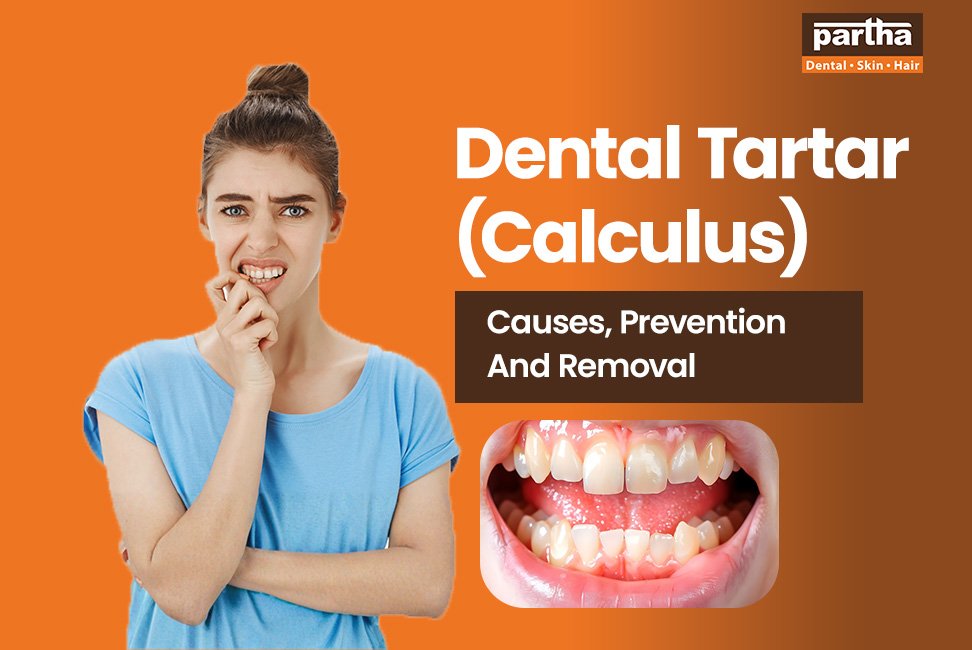
Dental tartar causes include when plaque hardens with minerals from saliva within 24 to 72 hours. Once hardened, brushing cannot remove it and only professional scaling can. If your teeth feel rough near the gums, look yellow or brown near the edges, or still seem unclean after brushing, tartar may already be building up.
Many people ignore it at first because it does not hurt. But when gums start bleeding, the mouth smells unpleasant, and home cleaning stops working, that small hygiene issue has turned into a gum problem that needs professional intervention.
At Partha Dental, our expert dentists have helped with oral problems for over 15 lakh patients across 120+ clinics using advanced ultrasonic scaling technology that cleans 40% faster than manual methods while causing minimal discomfort. Our tartar removal procedures have helped 89% of patients avoid gingivitis progression when treated within the first three months of buildup.
This comprehensive guide is written by an expert dentist from Partha Dental. Read this before you delay your tartar treatment any further.
What Is Dental Tartar And How Is It Different From Plaque?
Dental tartar is hardened plaque. Plaque is a soft, sticky film that forms on teeth every day. If you do not clean it properly, minerals in saliva harden it within 24 to 72 hours.
| Feature | Plaque | Tartar |
| Texture | Soft and sticky | Hard and rough |
| Colour | Clear to pale yellow | Yellow to brown |
| Removal | Brushing and flossing | Professional cleaning |
| Effect | Early irritation | Stronger gum problems |
The key difference is the technique used to remove these two. Plaque can be cleaned at home. However, tartar is not that simple to clean and needs professional help from a reliable dental clinic in Bangalore. That is why understanding dental tartar causes early helps you prevent it before it becomes a dentist’s job.
What Causes Dental Tartar To Build Up On Teeth?
Tartar forms when plaque remains on teeth for more than 24 hours and undergoes mineralization. This is a process where calcium phosphate crystals from saliva bind to the bacterial biofilm and create a cement-like deposit. This happens 3 times faster in some people due to specific habits, saliva composition, and oral conditions that either increase plaque production or reduce its removal.
Common Causes That Accelerate Tartar Formation:
- Irregular Brushing: Skipping even one brushing session allows plaque to remain on teeth for 12+ hours, doubling the mineralization risk. Brushing for less than 2 minutes leaves 30-40% of tooth surfaces uncleaned.
- Poor Flossing: The spaces between teeth account for 40% of all tooth surfaces. Without daily flossing, plaque hardens in these areas within 48 hours, creating interproximal tartar that only scaling can remove.
- Sugary or Starchy Foods: Foods high in refined carbohydrates (sweets, bread, chips) feed Streptococcus mutans bacteria, which produce acidic byproducts that accelerate plaque formation by 60% within 20 minutes of eating.
- Dry Mouth (Xerostomia): Saliva naturally washes away 25% of daily plaque. People with reduced saliva flow, due to medications, aging, or medical conditions build plaque 2 to 3 times faster than those with normal saliva production.
- Smoking or Tobacco Use: Tobacco reduces blood flow to gums by 50%, weakens immune response, and creates a rough surface on teeth where plaque adheres 4 times more easily. Smokers develop tartar 6 times faster than non-smokers.
- Crowded Teeth or Orthodontic Appliances: Overlapping teeth and braces create 15-20 additional plaque traps per quadrant where toothbrush bristles cannot reach. These areas harden into tartar within 3-4 days without specialized cleaning tools like interdental brushes or water flossers.
These factors explain why dental tartar prevention needs consistency and correct technique, not just occasional brushing.
What Are The Signs That Tartar Is Building Up On Your Teeth?
Tartar shows visible and physical signs within 3 to 7 days of formation, long before it causes pain or serious gum damage. Early detection happens through simple visual checks and running your tongue along your teeth to feel texture changes.
Common Symptoms of Tartar Build up in Mouth
- Yellow or brown layer near gums
- Rough or gritty feeling on teeth
- Bad breath that keeps returning
- Bleeding gums during or after brushing
- Teeth looking unclean even after thorough brushing
The rough surface of your teeth attract more plaque which is why early dental tartar removal helps prevent further buildup and gum irritation.
What Happens If You Do Not Remove Dental Tartar?
If tartar stays on the teeth, it keeps irritating the gums and holding bacteria in place. If you ignore the calculus build up in your mouth, you might have to face the following:
Stage-by-Stage Progression of Untreated Tartar
- Weeks 1-4: Gum Inflammation (Gingivitis Onset) Within the first month, tartar deposits release bacterial toxins that trigger your immune system to inflame gum tissue. Gums become red, swollen, and bleed during brushing in 80% of cases. At this stage, damage is still reversible with professional cleaning.
- Months 2-6: Established Gingivitis Tartar continues growing both above and below the gumline, creating subgingival deposits that your toothbrush cannot reach. Gums may recede 1-2 mm, creating pockets where bacteria thrive. Bad breath becomes chronic as anaerobic bacteria multiply in oxygen-deprived pockets.
- Months 6-12: Early Periodontitis Inflammation spreads deeper, affecting the periodontal ligament that holds teeth in jawbone. Bone loss begins at a rate of 0.1-0.2 mm per year in affected areas. Gum pockets deepen to 4-5 mm (normal is 1-3 mm). Once bone loss starts, it cannot regenerate naturally.
- 1-3 Years: Moderate to Severe Periodontitis Without intervention, 30-50% of supporting bone can dissolve around affected teeth. Teeth become mobile, shifting position or loosening. Pus may form in deep pockets. Tooth loss becomes likely without surgical intervention and bone grafting.
Many people delay treatment because there is no pain. That delay allows bacteria to stay active near the gums. Addressing dental tartar causes early reduces the risk of long-term gum issues.
Can You Remove Dental Tartar At Home Safely?
No. Once tartar hardens, you cannot remove it safely at home.
Brushing and flossing remove plaque, not hardened tartar. Trying to scrape it yourself can damage teeth and gums. Here’s how you:
- Can Scratch and Thin Enamel Permanently: DIY metal tools used without proper angulation can remove 10-50 micrometers of enamel per scraping attempt. Enamel does not regenerate, and once thinned, teeth become permanently sensitive to temperature and prone to decay.
- Can Lacerate and Infect Gum Tissue: Sharp instruments slip easily on hard tartar, cutting delicate gum tissue and creating entry points for bacteria. These wounds can develop into painful abscesses within 48-72 hours.
- Can Push Bacteria Deeper Into Gum Pockets: Improper scaling technique forces tartar fragments and bacteria below the gumline into 4-6 mm deep pockets, worsening infection and accelerating bone loss instead of preventing it.
- Cannot Remove Hidden Subgingival Deposits: Up to 60% of tartar forms below the gumline where you cannot see or reach it. Removing only visible deposits creates false reassurance while hidden tartar continues damaging bone and ligaments.
This is where many people confuse dental tartar prevention with dental tartar removal. Prevention happens at home. Removal needs a dentist.

How Do Dentists Perform Dental Tartar Removal?
Dentists remove tartar using scaling. The aim of the dental tartar removal process is to clean both visible and hidden buildup around the gums.
- 1. Oral Examination (5–10 minutes)
The dentist checks all tooth surfaces and measures gum pockets at 6 points per tooth. Normal depth is 1–3 mm, while 4+ mm suggests disease. Tartar above and below the gumline is identified, sometimes with X-rays. - 2. Ultrasonic Scaling (15–30 minutes)
A scaler vibrating at 25,000 to 50,000 cycles per second breaks tartar while water flushes debris. The tip removes 70–80% of deposits about 40% faster. - 3. Hand Scaling (10–20 minutes)
Curettes clean deeper pockets of 4–6 mm, removing deposits from root surfaces with controlled pressure. - 4. Polishing (5–10 minutes)
A rubber cup at 2,000–3,000 RPM smooths teeth and delays tartar buildup from 2–3 weeks to 4–6 weeks. - 5. Aftercare (5 minutes)
Guidance includes brushing at a 45-degree angle, flossing, and scheduling visits every 3 to 6 months.
Professional dental tartar removal improves gum health and makes daily cleaning more effective.
Is Dental Tartar Removal Painful And How Long Does It Take?
On a 0-10 pain scale where 10 is severe pain, most people rate routine scaling as 1-3 (mild discomfort). Some areas may feel moderately sensitive if gums are already inflamed or if tartar has formed deep below the gumline, requiring more intensive cleaning pressure.
For Routine Tartar Removal (Light Buildup)
- Duration: 30-45 minutes for full mouth cleaning
- Discomfort Level: 1-2 out of 10. Feels like gentle scraping and cool water spray
- Anesthesia: Usually not needed
For Moderate Tartar Buildup
- Duration: 60-90 minutes, often done in two appointments (upper teeth one visit, lower teeth another)
- Discomfort Level: 3-4 out of 10. Tolerable without numbing for most patients.
- Anesthesia: Topical numbing gel may be applied to gum areas.
For Heavy Buildup or Deep Scaling (Subgingival Tartar)
- Duration: 90-120 minutes, typically split into 2-4 appointments done 1-2 weeks apart.
- Discomfort Level: 4-6 out of 10 without anesthesia
- Anesthesia: Local anesthetic injection recommended to numb specific quadrants for patient comfort.
What Is The Best Way To Prevent Dental Tartar From Coming Back?
Preventing tartar means stopping plaque before it hardens. Daily care plays the biggest role here.
- Brush twice daily, 2 minutes, 45-degree technique
- Clean gumline carefully where tartar builds fastest
- Floss daily, clean 40% missed tooth surfaces
- Use fluoride toothpaste, avoid rinsing 30 minutes
- Use mouthwash short-term, reduces bacteria 30–40%
- Avoid tobacco, tartar forms 4–6 times faster
- Professional cleaning every 3–6 months recommended
People with tighter teeth or braces need more attention. That is where a good dental clinic in Bangalore or a trusted dental clinic in Chennai can guide you based on your mouth condition.
Get Professional Dental Tartar Removal At Partha Dental
Tartar does not clear with stronger brushing once it hardens. It keeps holding bacteria near the gums and makes the mouth harder to keep clean every day. At Partha Dental, our approach removes existing tartar deposits using advanced ultrasonic scaling technology while training you to prevent regrowth through personalized oral hygiene coaching. With 28+ years of dental excellence, presence across 120+ clinics in 4 states, 300+ specialist dentists, and 3 lakh+ verified patient reviews averaging 4.9/5 stars,we have built its reputation on delivering patients results and reliability.
Struggling with rough teeth, bleeding gums, or stubborn bad breath? Get expert tartar removal treatment at Partha Dental, trusted across Bangalore, Chennai, Hyderabad, and Mysore. Call 8019550000 today to schedule your professional scaling appointment.
FAQs
1. Can dental tartar come back after professional cleaning?
Yes, tartar can build up again if plaque is not controlled daily. Good oral care helps slow it down.
2. Does drinking more water help reduce tartar buildup?
Yes, water helps wash away food particles and bacteria. It also supports saliva, which naturally protects your teeth.
3. Can mouth breathing increase tartar formation?
Yes, it can dry out your mouth and reduce saliva flow. This makes plaque harden faster into tartar.
4. Are electric toothbrushes better for preventing tartar?
They can clean more effectively in hard to reach areas. Many people find them easier for maintaining consistent technique.
5. Can diet changes help control tartar buildup?
Yes, reducing sugary and sticky foods helps limit plaque formation. A balanced diet supports better oral health overall.