













A missing or failing tooth doesn’t just affect how you eat, it changes how you speak and how confident you feel when you smile. Before booking one, here are the things to know before getting dental implants that actually change how your treatment goes, not generic reassurance.
Partha Dental starts every case with a CBCT scan, with dentists and oral surgeons involved in planning from the first visit. That single step answers most queries about things to know before getting dental implants.
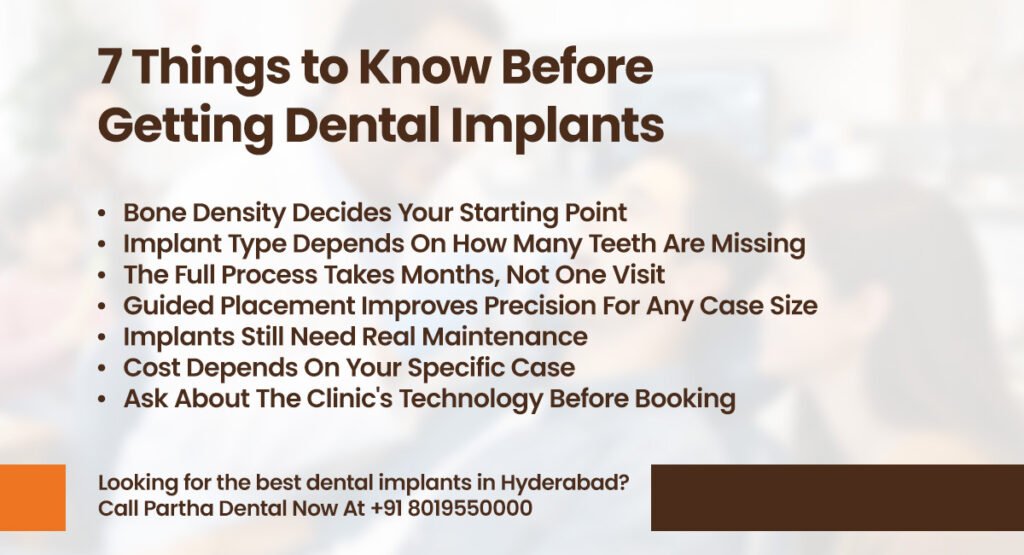
Here’s the list of, expert explained, 7 things to know before getting dental implants in Hyderabad.
Not Every Jaw Qualifies the Same Way
Bone density and gum health decide whether you’re ready for an implant right now. Sometimes something needs treating first. A thin or shrunken jawbone sometimes needs a bone graft before an implant can go in at all.
This is also why waiting matters. Studies published through the U.S. National Library of Medicine have found that roughly 30% of the jawbone at a missing-tooth site can be lost within the first few months after extraction. Most of that loss happens in the first 3 to 6 months. That’s part of why dentists often recommend evaluating implant options sooner rather than later.
The dental clinic in Vasanthalipuram checks this with a CBCT scan at the very first visit. That happens before any treatment date gets discussed.
The Right Implant Type Depends on How Many Teeth Are Missing
One missing tooth usually needs a single implant. Several missing teeth in a row can often use an implant-supported bridge instead of one implant per gap. The comparison of single tooth, All-on-Four, and full mouth implants covers this in more depth.
Cases needing more implants and more surgical planning are usually routed to a hospital-tier facility. The dental hospital in Kondapur handles these larger multi-implant cases specifically for that reason.
Research published through the U.S. National Library of Medicine has reported long-term dental implant success rates frequently exceeding 95% under favorable conditions. Outcomes still depend on individual factors like bone health and case complexity.
The Full Process Takes Months, Not One Visit
Implant treatment isn’t a single appointment. The post needs 3 to 4 months to fuse with the jawbone. Dentists call this osseointegration. Only after that does a permanent crown go on top.
The best dental clinic in Madhapur maps this full timeline out during the first consultation. That way, there’s no surprise about how long it actually takes.
Guided Placement Changes the Precision, Not Just the Marketing
Guided implant placement uses a digital scan to plan the exact angle and depth of each implant before surgery starts. This matters for a single implant too, not only complex cases. The full explanation of guided implant placement covers what the planning software actually checks before the day of surgery. A dental implant in Nallagandla using this guided approach follows the same digital planning step as any other Partha Dental branch.
Implants Still Need Real Maintenance
An implant can’t get a cavity, but the gum and bone around it can still develop disease if it’s neglected. Peri-implant gum disease is a real risk. It’s managed the same way regular gum disease is: brushing, flossing, and regular checkups.
Skipping checkups is the most common way an otherwise successful implant runs into trouble years later. The bone around the implant needs the same attention as bone around a natural tooth root. A dentist checks this at routine visits, not just when something already feels wrong.
Cost Depends on Your Specific Case, Not a Flat Rate
A single implant costs less than a multi-implant case. The real number depends on bone grafting needs, the number of implants, and the final crown or bridge material. The best dental hospital in Nizampet confirms exact costs only after the CBCT scan, not from a phone call estimate.
The Clinic’s Technology and Experience Actually Matter
Not every provider uses guided placement or digital scanning. Ask specifically whether your dentist plans implants with a CBCT scan and guided surgery. That affects both precision and how predictable your recovery is.
The number of implants a dentist places regularly also matters, especially for multi-implant or bridge cases. A provider who handles both single-tooth and complex cases routinely can usually spot problems earlier. They can adjust the plan before surgery, not during it.
At a Glance: What Changes Between a Single Implant and Multiple Implants?
| Factor | Single Implant | Multiple Implants |
| Typical facility | Standard dental clinic | Hospital-tier facility with more surgical capacity |
| Planning step | CBCT scan, one site | CBCT scan, multiple sites mapped together |
| Healing time | 3 to 4 months | Similar per implant, full case often takes longer |
| Cost driver | Mostly the implant itself | Number of implants, bone grafting, bridge material |
Book a Consultation for Dental Implants in Hyderabad With Partha Dental Now!
None of these seven things replace an actual evaluation. They’re what to ask about and expect, not a substitute for a dentist checking your mouth directly.
Partha Dental runs the same CBCT-guided planning process across 120+ clinics and 300+ doctors in South India, with dentists and oral surgeons involved in implant planning and placement. That holds for single implants and multi-implant cases alike. No treatment plan gets finalised before the scan confirms what your jaw can actually support.
Book a consultation at your nearest Partha Dental clinic, or call us at +91 8019550000 to schedule an appointment.
Frequently Asked Questions
How Long Does the Entire Implant Process Take From Start to Finish?
Most cases take 4 to 6 months total. That includes healing time before the final crown or bridge goes on. The best dental clinic in Madhapur walks patients through this timeline at the first consultation, before any surgery date is booked.
Is Guided Implant Placement Worth Asking About for a Single Tooth?
Yes. It improves precision regardless of case size, since the angle and depth get mapped digitally before surgery instead of judged by hand during the procedure. A dental implant in Nallagandla planned with guided placement follows the same digital-scan process used for larger multi-implant cases. A single tooth gets the same level of planning as a full arch.
What Happens if I Don’t Take Care of My Implant Long-Term?
Peri-implant gum disease can develop around a neglected implant, similar to gum disease around natural teeth. Left unchecked, it can affect the bone holding the implant in place, not just the surrounding gum tissue. It’s preventable with regular brushing, flossing, and dental checkups, the same basics that protect natural teeth.
Why Does the Cost Estimate Change After My Consultation?
The initial range is based on typical cases, not your specific jaw. The best dental hospital in Nizampet confirms your actual cost only after the CBCT scan. That scan shows your bone density, whether a graft is needed, and the number of implants required. All of that shifts the final number.