











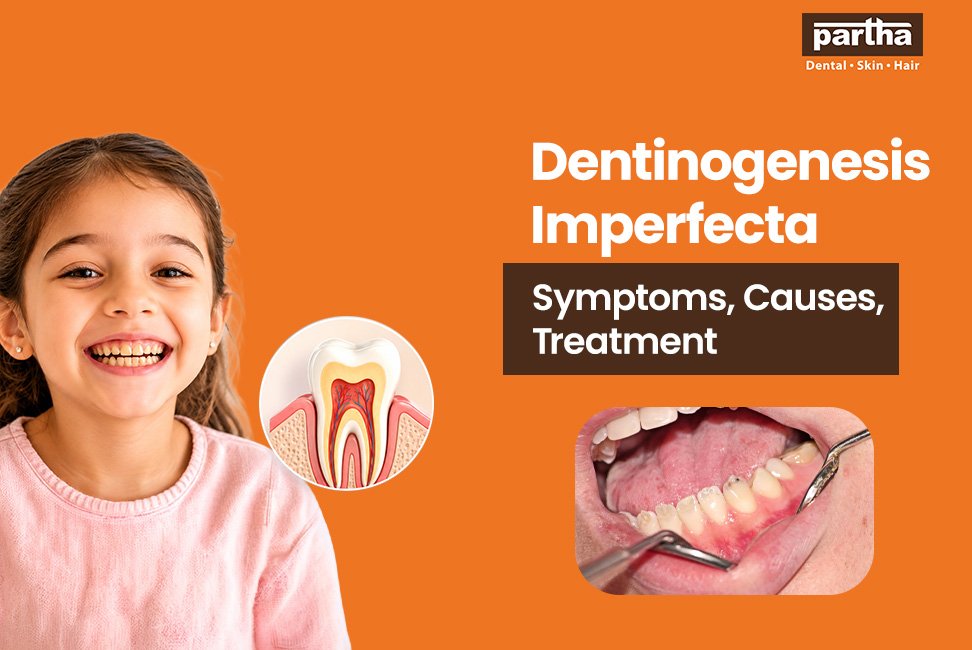
A toddler’s first teeth come through and the colour isn’t right. Not stained from food. Not dirty. Just a different colour entirely. Then a dentist says: dentinogenesis imperfecta.
Dentinogenesis imperfecta is a genetic condition where the dentin inside the teeth doesn’t form correctly, leaving them structurally weak from the moment they appear. It isn’t caused by diet, brushing habits, or anything a parent did. It’s present from birth.
At Partha Dental, specialists with over 28 years of experience across kids dentistry and restorative care manage these cases. Read on to understand what dentinogenesis imperfecta is, what causes it, and what treatment is followed across a child’s life.
What Is Actually Happening Inside The Tooth?
The outer white layer is enamel. It’s the hardest material in the human body, but it’s thin. What gives a tooth its strength and bulk is the layer underneath it called dentin. In dentinogenesis imperfecta, the dentin doesn’t form properly. It’s softer, less organised, and structurally weaker than it should be.
The enamel on top forms normally in most cases, but without adequate support beneath it, it fractures and chips off. Once enamel is gone, the exposed dentin underneath wears down rapidly. That’s why these teeth deteriorate faster than expected.
Why Do DGI Teeth Look the Way They Do ?
- Normal dentin is pale yellow. DGI dentin is often darker, more translucent, or has a different mineral composition.
- When light passes through the enamel and hits the altered dentin underneath, the tooth appears blue-grey, amber, yellow-brown, or opalescent, which means it has a glassy, iridescent quality.
Dentinogenesis Imperfecta Symptoms: What You See At Home And What The Dentist Sees On X-Ray?
The signs parents notice first are usually visual, and they appear as soon as the teeth erupt. At home, you may notice these dentinogenesis imperfecta symptoms:
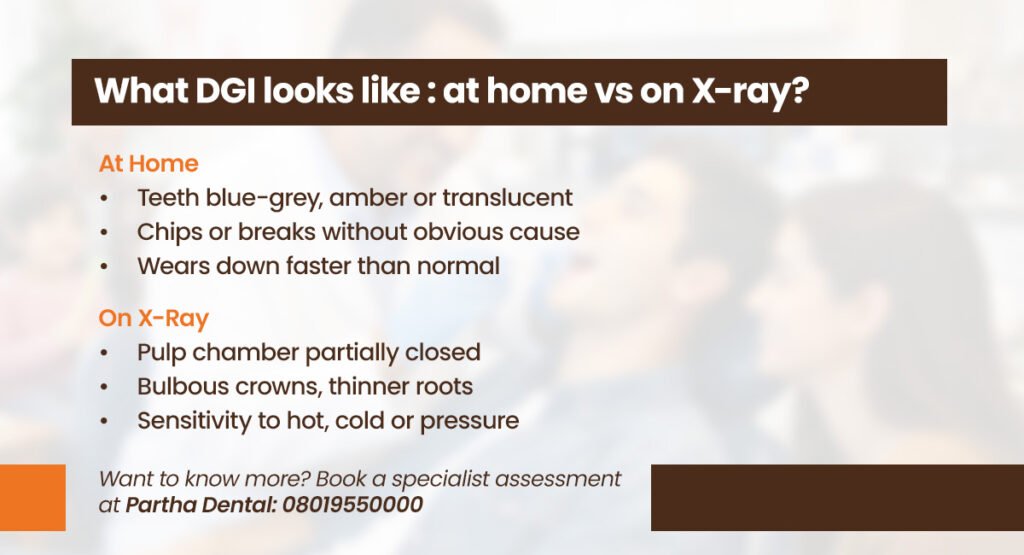
- Teeth that are blue-grey, amber, brownish, or translucent instead of white
- A glassy or shiny appearance, different from normal teeth
- Teeth that chip or break more easily than expected
- Rapid wear, especially on the biting surfaces
- Sensitivity to temperature or pressure
- Teeth that appear smaller or more rounded in shape than normal
Children with significant wear sometimes have trouble chewing comfortably. Speech can be affected if the front teeth wear down or break at a young age.
What The Dentist Sees On Imaging?
An OPG, which is a full-mouth panoramic X-ray, reveals things invisible to the eye. In DGI, the inner canal of the tooth, called the pulp chamber, is often partially or completely filled in. This is called pulp obliteration.
- The roots may appear shorter or thinner than expected.
- The crown of the tooth may look wider and more bulbous than a normal tooth.
These X-ray findings matter because they affect which treatments are feasible. A tooth with no remaining pulp canal can’t receive conventional root canal treatment, for example.
What Causes Dentinogenesis Imperfecta And Did I Pass It On?
Dentinogenesis imperfecta causes start at the genetic level. A change in the DSPP gene disrupts how dentin forms inside the tooth. The dentin that develops is weak from the start. Nothing the parent did caused this. It happens before the child is born.
The condition passes through families. If one parent has it, each child has a 50% chance of inheriting it. But that’s not the whole picture:
- Sometimes it is linked to bone disease. DGI Type I appears in children who also have osteogenesis imperfecta, a condition that makes bones break easily. If your child has unusual teeth and a history of unexplained fractures, tell both the dentist and the paediatrician.
- Indian families face a slightly higher risk. Recessive forms of osteogenesis imperfecta are more common in Indian families than in other populations. A dentist at the best dental clinic in Chennai or anywhere in South India who finds Type I DGI may suggest a broader health check for this reason.
- Sometimes it appears with no family history at all. This is called a de novo mutation. The gene change happened for the first time in that child. Both parents can have completely normal teeth and still have a child with DGI.
Dentinogenesis Imperfecta Treatment : Baby Teeth And Permanent Teeth Need Different Plans
Baby teeth and permanent teeth are not treated the same way in DGI. The goals of the best dental hospital in Kondapur are different at each stage.
- Baby teeth: The goal isn’t primarily cosmetic. It’s protective and structural. Stainless steel crowns are placed over DGI baby teeth to protect the surface and prevent further wear. Composite coverage is used for less severe cases. The child’s dentist monitors eruption timing closely so any space loss is caught before it affects the permanent teeth.
- Permanent teeth as they come through: Dental crowns are the primary protective option for DGI permanent teeth. They cover and seal the tooth surface, protecting the weakened dentin from further wear and fracture.
- Adult restorative options: Adults with DGI who lost teeth earlier in life, or whose teeth have worn severely, have access to options that weren’t always available at diagnosis. Dental implants are the most stable long-term replacement for missing teeth. Smile designing at Partha Dental can be part of this planning for adults who’ve carried this condition since childhood and want to address the cosmetic dimension properly now.
Treatment for DGI at a dental clinic in Whitefield is lifelong monitoring and staged intervention, not a one-time fix. A child managed well through each stage reaches adulthood with far more options than one who wasn’t.
Your Child’s Teeth Deserve a Specialist. Start with Partha Dental.
If your child’s teeth came through looking different, or if you’ve been managing DGI since childhood and want to understand dentinogenesis imperfecta treatment options now, a proper specialist assessment is the right starting point.
With over 15 lakh patients treated, and 300+ doctors across South India, Partha Dental specialists cover kids dentistry, restorative care, implant planning, and smile designing within the same network. Book a consultation for a dental clinic near me at: 08019550000.
Frequently Asked Questions
I have a DGI. Does that mean my children will definitely have it too?
Not definitely. DGI is autosomal dominant, which means each child has a 50% chance of inheriting it. Some children do, some don’t.
Are DGI teeth more likely to get cavities?
The research is mixed on this. DGI doesn’t directly increase cavity-causing bacteria, but once enamel chips off and dentin is exposed, that surface is far more vulnerable to decay than intact enamel.
My child’s DGI teeth keep chipping. What’s the right thing to do?
See a dentist soon rather than waiting for the next routine check-up. Repeated chipping means the tooth surface needs protection now.