











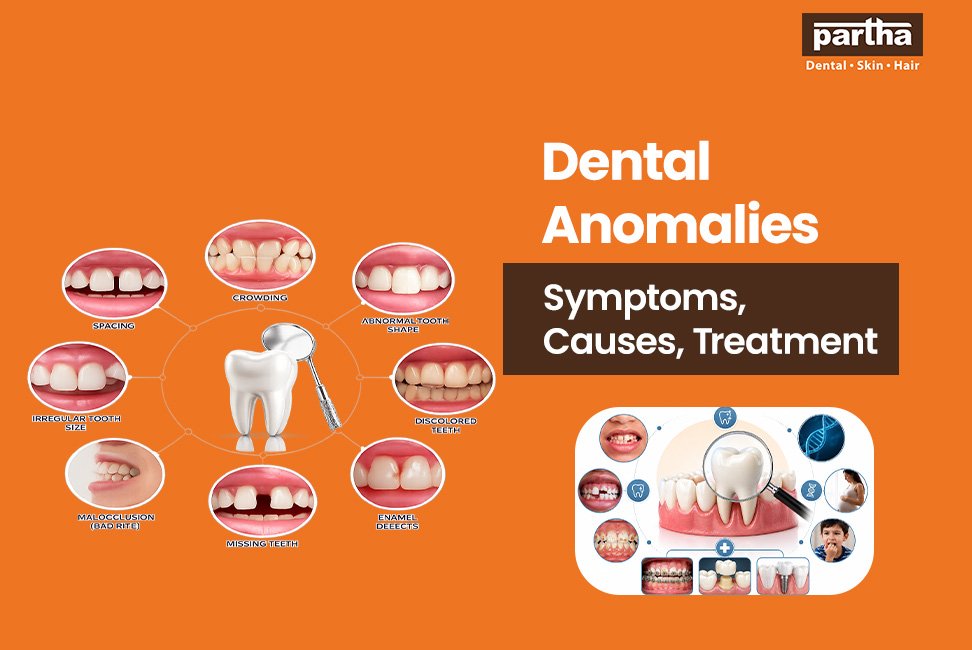
Got an extra tooth growing where it shouldn’t. Or a bite that’s always been slightly off. These problems are not separate with separate causes. These are dental anomalies, and they show up in most people .
A research published in the Journal of Clinical and Experimental Dentistry found 36.7% of patients had at least one dental anomaly on a panoramic X-ray.
Some anomalies need treatment. Many just need watching. The dentist at Partha Dental decides after examining the teeth and reviewing imaging. These assessments involve specialists who work across different dental fields, so patients get a proper answer rather than a guess.
Read on to understand what dental anomalies look like, what causes them, and what treatment actually involves.
What Exactly Are Dental Anomalies?
Dental anomalies are differences in how teeth develop. A tooth may be missing, extra, unusually shaped, poorly formed, or growing in the wrong position. These differences happen during tooth formation, which begins before birth and continues through childhood.
- Some anomalies are present at birth.
- Others show up only when teeth start to erupt.
- A few are found by accident on an X-ray during a routine visit, with no dental anomalies symptoms at all.
What Are The Different Types Of Dental Anomalies?
Dentists group anomalies by what they affect, because the type determines the treatment path.
- Tooth number is one category. Hypodontia means one or more teeth never developed. Hyperdontia means extra teeth formed alongside the normal ones.
- Size and shape form another category. Microdontia means a tooth is abnormally small. Macrodontia means it’s abnormally large. Peg-shaped lateral incisors, where the upper side teeth grow pointed and narrow, are a common shape anomaly.
- Position is a third category. A tooth may erupt in the wrong place, grow at the wrong angle, or stay stuck inside the jaw entirely.
What Symptoms Do Dental Anomalies Cause?
Many anomalies don’t cause pain. Parents often bring children in because a tooth hasn’t come through by the expected age, or because a permanent tooth is growing behind a baby tooth instead of replacing it. Adults sometimes notice only when a dentist points something out on an X-ray.
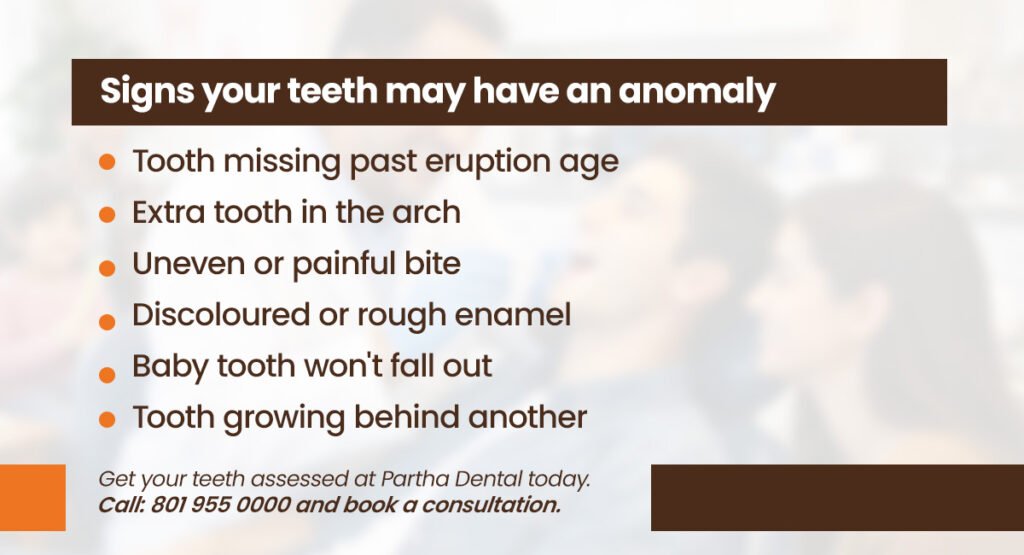
When dental anomalies symptoms do show up, these are the ones patients describe most:
- A visible gap with no tooth present
- An extra tooth growing behind or beside the normal teeth
- A tooth that looks much smaller or differently shaped
- Teeth that are discoloured, pitted, or feel rough
- Difficulty chewing on one side
- A bite that doesn’t close evenly
- Jaw discomfort after eating
- Speech that’s unclear with certain sounds
A routine dental check-up at the best dental clinic in Hyderabad catches more anomalies than pain does.
What Causes Dental Anomalies?
Tooth development is a long, sensitive process. It starts around the sixth week of pregnancy and continues through early childhood. A lot can influence it during that window.
Is Genetics Involved?
Often, yes. Missing teeth in particular run in families. Hypodontia is linked to changes in specific genes, which control how tooth buds form. This connection is documented in the European Journal of Human Genetics. If a parent has missing teeth or peg-shaped lateral incisors, the child’s risk is higher.
Can an illness during pregnancy affect a child’s Teeth?
It can. High fever, serious infection, or low levels of vitamin D or calcium during early pregnancy can disrupt the formation of tooth buds. The effect often doesn’t appear until those teeth try to erupt years later.
What Role Do Childhood Injuries Play?
A fall that damages a baby tooth can disturb the permanent tooth developing underneath it. The damage may take the form of dilaceration, where the root grows at an abnormal angle, or enamel defects that show up when the permanent tooth eventually erupts. Dental follow-up after any tooth injury in a child matters for this reason.
Do Habits Like Thumb-Sucking Are Dental Anomalies Causes?
Prolonged thumb-sucking past age three can shift teeth over time. Losing a baby tooth earlier than expected, without placing a space maintainer to hold the gap, lets neighbouring teeth drift into the space. And when the permanent tooth tries to come in, there’s not enough room. It ends up in the wrong position, or doesn’t come through at all.
How Are Dental Anomalies Treated?
The first question a dentist at the dental hospital in Koramangala asks is whether the anomaly is actually causing a problem. Not all of them need to be fixed. Some are monitored for years with no intervention. A dentist won’t recommend a procedure unless there’s a real reason for it.
If something doesn’t look right, the sensible step is to have it assessed. As the treatment is based on whether the anomaly affects:
- Bite
- Oral health
- Or causes real functional concern.
When treatment is needed, the approach depends entirely on the type.
- For position problems, tooth braces or clear aligners move teeth that are rotated, crowded, or growing at the wrong angle.
- For shape and size problems, the tooth can often be rebuilt. Composite bonding adds material to a tooth that’s too small. Dental crowns cover a tooth that’s structurally compromised or differently shaped.
- For missing teeth, dental implants are the most stable long-term replacement once the jaw stops growing, usually around age 18.
- For extra teeth, extraction is usually the right dental anomalies treatment.
Get a Specialist Assessment at Partha Dental
If you’ve noticed an unusual tooth in your child’s mouth, or something about your own bite has never felt quite right, the place to start is a proper clinical assessment.
Partha Dental has treated over 15 lakh patients across South India with the best dentist in Gachibowli for patients who need input from more than one specialist. The network covers orthodontic evaluation, restorative planning, kids dentistry, and oral surgical care under one roof, supported by OPG and digital RVG imaging.
Call : 801 955 0000 and book a consultation at your nearest clinic to get a clear answer on what your teeth actually need.
Frequently Asked Questions
Are dental anomalies really that common in India?
Indian research found over a third of patients had at least one anomaly visible on X-ray. Positional anomalies like rotation were the most frequent.
Can an anomaly be treated in childhood and again in adulthood?
Yes. Some anomalies are managed in stages. A space maintainer in childhood, orthodontic treatment in the teenage years, and a dental implant after the jaw has finished growing is a common sequence.
Is the treatment for dental anomalies expensive?
It varies. Some anomalies need nothing more than monitoring, which costs nothing beyond the check-up. Others need orthodontic treatment, restorations, or surgical procedures, which are priced based on the specific treatment plan.
What’s the difference between a dental anomaly and just having crooked teeth?
Crooked teeth are a position issue that often comes from crowding or habits. A dental anomaly is a developmental difference in how a tooth formed, its structure, size, number, or position from the start.