








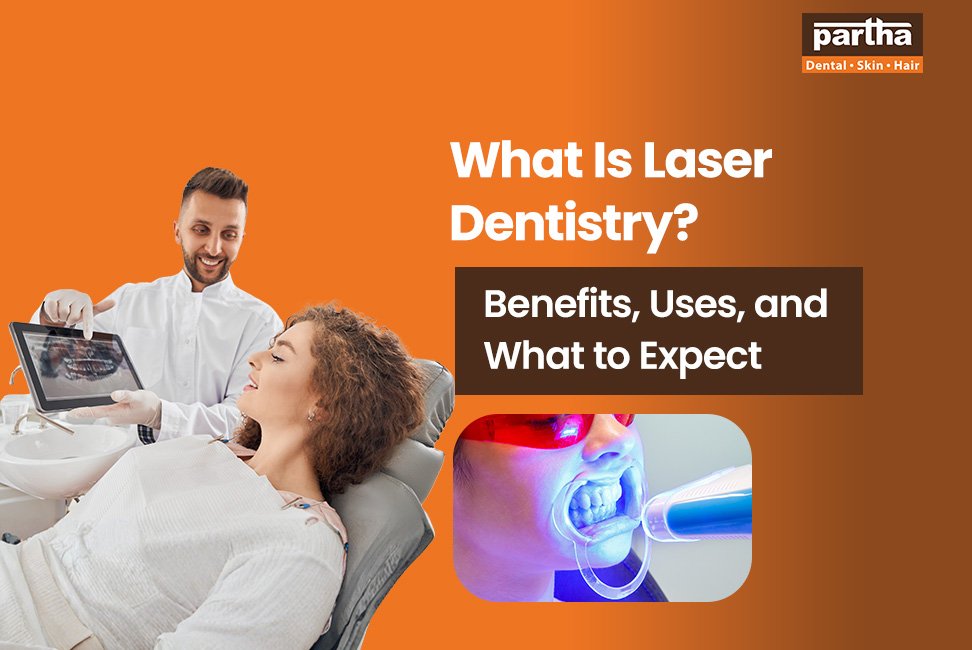
Someone told you laser dentistry means no drill, no needle, no pain. That’s partially true. Laser dentistry uses a focused beam of light energy to treat specific areas of the tooth, gum, or soft tissue. For the right procedures, laser dentistry results are more precise, cause less bleeding, and heals faster than conventional methods.
If you’re trying to understand whether laser dentistry is right for your specific problem, this guide by Partha Dental with 120+ clinics, and a 4.8★ Google rating across South India, will explain laser dentistry benefits, uses and the results to expect when the clinical case supports it.
What Is Laser Dentistry and How Does It Work?
Laser dentistry uses focused light energy to cut, reshape, or treat tissue in the mouth with far more precision than a conventional drill or scalpel. The laser beam targets only the specific area being treated. Surrounding healthy tissue is left untouched.
There are two types of dental lasers, and they work on different parts of the mouth:
| Laser Type | What It Treats | Common Uses |
| Hard tissue laser | Teeth and bone | Cavity detection, decay removal, sensitivity treatment |
| Soft tissue laser | Gums and soft tissue | Gum reshaping, frenectomy, gum disease treatment, cold sore treatment |
The type your dentist uses depends on what’s being treated. Most best dental clinic in Vijayawada use soft tissue lasers more routinely because that’s where laser-assisted care offers the clearest clinical advantage.
What Can Laser Dentistry Actually Treat and What Can’t It?
Laser dentistry works well for specific procedures. It isn’t a universal solution for every dental problem and a dentist who recommends it for everything should be questioned.
Laser Dentistry Uses:
- Gum Reshaping : In removing or recontouring excess gum tissue. Precise, minimal bleeding, fast recovery.
- Gum Disease Treatment : For laser-assisted removal of infected tissue from gum pockets. Reduces bacteria without cutting.
- Frenectomy : When releasing a tongue tie or lip tie. Often completed in 15 to 20 minutes with minimal post-procedure discomfort.
- Cold Sore and Canker Sore Treatment : Laser reduces healing time and pain significantly.
- Cavity detection : Lasers can identify early decay before it’s visible to the eye.
- Teeth Whitening Activation : Some whitening treatments use laser light to activate the bleaching agent faster.
Where Lasers Don’t Replace Conventional Tools?
According to a review of 67 studies published in NCBI (2023), lasers are not ideal for removing deep cavities or hard restorative materials like amalgam or ceramic crowns. Complex extractions still need conventional instruments.
What Are the Real Laser Dentistry Benefits?
Laser dentistry benefits are real but they’re procedure-specific. Here’s what actually changes for the patient:
- Less Bleeding: The laser seals blood vessels as it works. Soft tissue procedures that would normally bleed with a scalpel cause minimal bleeding with a laser.
- Faster Soft Tissue Healing: Because the incision is more precise and blood vessels are sealed simultaneously, the wound is smaller. Smaller wound, faster recovery. Partha Dental’s documentation confirms frenectomy recovery is typically 3 to 5 days with laser treatment.
- Reduced Anaesthesia In Selected Cases: Not all cases. But for some soft tissue procedures, the laser’s precision means a local anaesthetic isn’t needed.
- Less Post-Procedure Swelling: Less trauma to surrounding tissue means less inflammatory response. Patients often notice that gum procedures feel better sooner than expected after laser treatment.
- No Drill Noise: For patients with dental anxiety, the absence of vibration and the drill sound changes the experience.
A 2023 review of 67 clinical articles published on NCBI confirms photobiomodulation, a laser-based tissue healing technique, shows measurable benefit in reducing inflammation and supporting recovery after soft tissue procedures.
What Happens During a Laser Dental Procedure? From the Patient’s Chair
Patients visiting the best dental clinic in Hyderabad for laser dentistry often want to know what the treatment actually feels like. While the exact steps vary by procedure, most laser treatments follow a similar process and are designed to make the experience more comfortable and precise. Here’s what typically happens during the appointment.
- Before The Procedure
Your dentist explains what will be done and why the laser is being used for your case. Protective eyewear is placed on you and the clinical team because the laser wavelength is harmful to unprotected eyes. If anaesthesia is needed, it’s applied at this point.
- During The Procedure
There’s no drill sound. No vibration. No pressure on the tooth. You may feel mild warmth or a faint tingling sensation at the treatment site. Some patients notice a slight smell of heat on tissue. This is normal and not harmful.
Duration varies by procedure. A frenectomy takes 15 to 20 minutes. Gum reshaping takes 30 to 45 minutes. Cavity detection is a matter of minutes..
- After The Procedure
The treated area may feel tender for a day or two. There’s minimal bleeding in most soft tissue cases. No stitches are needed for many laser gum procedures at the best dental clinic in Chennai. Aftercare looks like:
- Soft foods for 24 to 48 hours
- Gentle brushing around the treated area
- Saltwater rinse after meals
- Avoid hot or spicy foods for the first day
This is a general food guide, your dentist gives specific aftercare instructions based on your case.
The Right Question Isn’t “Is Laser Better?” It’s “Is Laser Right for My Case?”
Partha Dental uses dental laser-assisted treatment for selected gum and soft tissue procedures when it suits the patient’s condition. The dentist recommends it only after checking the issue, the treatment goal, and whether laser support can improve comfort, precision, or healing.
If you have a gum problem, frenectomy need, early decay concern, or dental anxiety, book a case-specific consultation at Partha Dental. You can visit your nearest clinic in Hyderabad, Chennai, Vijayawada or the best dental clinic in Bangalore.
Call 801 955 0000 to book your appointment today.
Frequently Asked Questions
Is laser dentistry painful?
For most soft tissue procedures, discomfort is significantly reduced compared to conventional methods. In some hard tissue cases, local anaesthesia is still used. It depends on the procedure, not on the word “laser” alone.
Is laser dentistry safe?
Yes, when performed by a trained dentist using the correct laser type for the procedure. Protective eyewear is used throughout. As with all clinical tools, safety depends on proper training and appropriate clinical selection.
Does laser dentistry cost more than traditional treatment?
It depends on the procedure and the clinic. In many cases, the cost is comparable because the laser simply replaces another instrument for the same procedure. Ask your dentist for a specific quote for your case.
How long does recovery take after laser dental treatment?
It depends on the procedure. Laser frenectomy recovery is typically 3 to 5 days. Gum reshaping recovery varies by the extent of treatment. Most patients notice soft tissue feels better sooner after laser treatment than after conventional surgery.
Is laser dentistry available for children?
Yes, for appropriate procedures. Frenectomy for tongue tie or lip tie is one of the most common laser procedures performed on children and infants. The dentist assesses suitability based on the child’s age, the condition, and clinical need.