










If you smoke and are thinking about dental implants, your first cause to worry is not the procedure but the treatment’s success rate. Due to this, many smokers fear implant failure, slow healing, gum infection, or being told they are not fit for the treatment after finally deciding to replace a missing tooth.
Dental implants for smokers are risky, but it does not always rule out treatment. With proper planning, strong oral hygiene, gum care and precautions before plus after surgery, many smokers still go ahead with implants successfully.
At Partha Dental, our specialists assess bones and gum health, smoking history before planning implant treatment. We guide you honestly, help you improve your chances of success, and tell you what to expect at every stage.
Read further to know when implants can still work well for smokers.
Can Smokers Get Dental Implants?
Yes. Smokers can get dental implants. But the honest answer has more to it.
Smoking does not disqualify you from getting an implant. What it does is raise the stakes. Your body needs to fuse the titanium post with your jawbone after surgery through a process called osseointegration. Smoking slows this process down significantly and in some cases stops it altogether.
Think of it this way. Your jawbone is like soil and the implant is a seed. For the seed to take root it needs water, oxygen and nutrients. Smoking cuts off that supply. The seed may still grow but it needs far more care and the right conditions to do so.
Your dentist will assess:
- Bone density in your jaw
- Current gum health
- How heavily and how long you have smoked
- Whether bone grafting is needed before the implant
If your bone and gum health meet the threshold, your implant journey can begin.
How Smoking Affects the Success of Dental Implant Treatment?
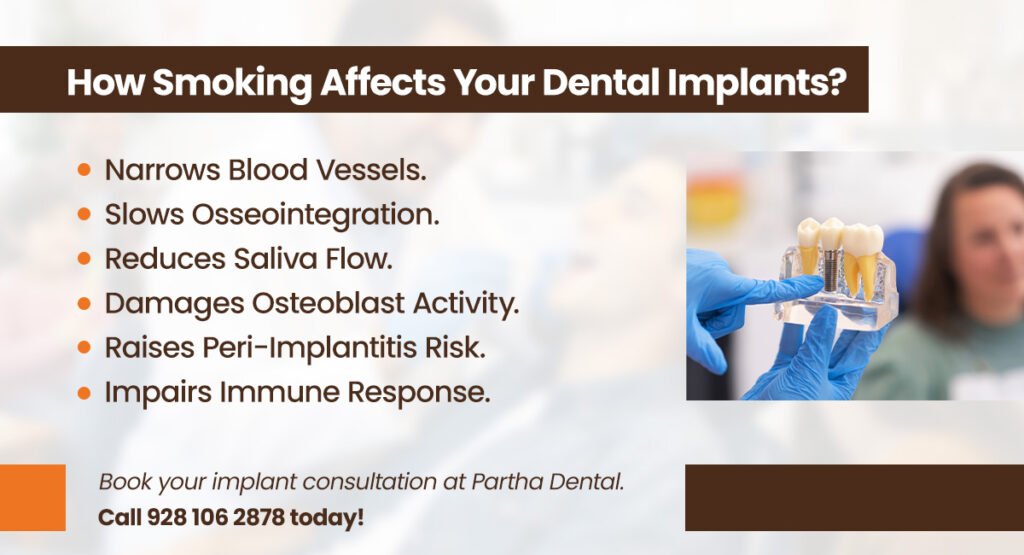
This is where dental implants for smokers become more complicated than a routine procedure. Nicotine is the primary culprit and it disrupts your body’s healing in several ways.
Each cigarette you smoke after surgery does not just slow healing. It actively works against the foundation your implant needs to survive. The upper jaw is particularly vulnerable because its bone density is naturally lower than the lower jaw making osseointegration harder even without tobacco in the picture.
Dental Implants Success Rates in Smokers vs. Non-Smokers
Numbers tell the clearest story. Here is what the research shows about dental implants success rates across different patient groups.
| Patient Type | Success Rate |
| Non-smokers | 95% to 98% |
| Light smokers | 85% to 90% |
| Heavy smokers (20+ cigarettes/day) | Below 85% |
| Smokers who quit before surgery | Close to non-smoker rates |
Early implant failure typically happens between 3 and 12 months after placement which is the same window in which osseointegration should be completing. Heavy smokers face the greatest risk in this period.
The upper jaw shows higher failure rates in smokers than the lower jaw. The bone in your upper jaw is less dense to begin with. When you add nicotine-impaired healing to the mix the implant has far less to hold on to.
Quitting smoking even a few weeks before surgery can push your success rate noticeably closer to that of a non-smoker.
Does Vaping Affect Dental Implants Too?
A lot of patients assume vaping is the safer option. It is not, at least not when it comes to dental implants.
E-cigarettes still deliver nicotine into your bloodstream. Nicotine narrows blood vessels regardless of whether it comes from a cigarette or a vape pen. The heat generated by vaping also damages the soft tissue in your mouth and around the implant site.
Here is what vaping does to your implant:
- Nicotine from vaping restricts blood flow to the gum and bone just like cigarettes do.
- The heat from vapour irritates and dries out oral tissues slowing healing.
- Vaping raises peri-implantitis risk even in nicotine-free products due to tissue irritation.
- E-cigarettes slow bone cell activity, so the bone takes longer to grow around the implant.
If you switched to vaping thinking it would make your implant safer your dentist needs to know. The risk profile is different from cigarettes but the threat to your implant is very real.
What to Expect Before, During and After Implant Surgery as a Smoker
Knowing what lies ahead helps you prepare better. Here is a straightforward timeline for smokers going through the implant process.
Before surgery:
- Stop smoking at least 2 weeks before your procedure. The longer you stop the better your healing will be.
- Your dentist will take X-rays or a 3D CBCT scan to check bone density and plan placement.
- If bone loss is significant you may need a bone graft first. This adds time but makes the implant far more stable.
- Be completely honest about how much you smoke. Your treatment plan depends on it.
On surgery day:
- The implant gets placed into the jawbone under local anaesthesia.
- The procedure takes about 1 to 2 hours depending on complexity.
- You go home the same day.
After surgery:
- Avoid smoking for at least 2 months. This is the most critical window for osseointegration.
- Keep up with prescribed antibiotics and follow every post-op instruction your dentist gives you.
- Attend all follow-up visits. Smokers need more frequent monitoring than non-smokers.
- Watch for warning signs like persistent pain, swelling or unusual discharge around the implant site.
How to Improve Dental Implant Success Rate as a Smoker?
You have more control over the outcome than you might think. These steps make a real difference:
- Quit or reduce smoking before surgery.
- Consider nicotine replacement if quitting is difficult.
- Brush twice daily and floss around the implant.
- Use dentist-recommended antibacterial mouthwash daily.
- Avoid alcohol during the healing period.
- Schedule check-ups every 3–4 months.
- Inform the dentist about all nicotine products.
Get Expert Dental Implants at Partha Dental in Hyderabad
If you are a smoker looking for dental implants in Hyderabad, you need a team that does not give you a generic treatment plan. At Partha Dental, our implantologists assess your bone density, gum health and smoking history before recommending any procedure.
We use 3D CBCT imaging for precise placement planning and offer bone grafting where needed. With 120+ clinics across South India and over 15 lakh happy patients, we have the experience to handle complex cases including high-risk smoker profiles.
Open honest consultations and no pressure to proceed until you are ready. Book your implant consultation at Partha Dental today. WhatsApp 942 942 2020 or call 801 955 0000.
FAQs
Can smokers get dental implants in Hyderabad?
Yes. Smokers can get dental implants in Hyderabad but success depends on bone density, gum health and smoking frequency. Partha Dental’s implantologists assess all these factors before recommending a treatment plan.
How does smoking affect dental implant success rates?
Smoking reduces dental implant success rates from 95–98% in non-smokers to 85–90% in smokers. Nicotine restricts blood flow and slows osseointegration making healing significantly harder.
How long should I stop smoking before getting a dental implant?
Dentists recommend stopping smoking at least 2 weeks before implant surgery and for at least 2 months after. The longer you stay smoke-free the closer your success rate gets to that of a non-smoker.
Does vaping affect dental implants?
Yes. Vaping delivers nicotine into your bloodstream which restricts blood flow to the implant site just like cigarettes do. The heat from vapour also damages oral tissue and raises the risk of peri-implantitis.
What is the failure rate of dental implants in smokers?
Smokers face a failure rate of up to 15.8% compared to just 1.4% in non-smokers. Heavy smokers who smoke 20 or more cigarettes a day face the highest risk of early implant failure.