












Table of Contents
In case if you are on the looking for braces treatment in Sangareddy city, it is quite possible that you are looking for orthodontic care to achieve bright and healthy smile. If you are facing all types of problems like crowded teeth, gaps, or bite problems, knowing the benefits of braces for you is the most important thing to do first. The blog explains thoroughly the basics of braces that every patient must know, like the various options that exist, the lengths of the treatments and in addition, why quality orthodontic care is important.
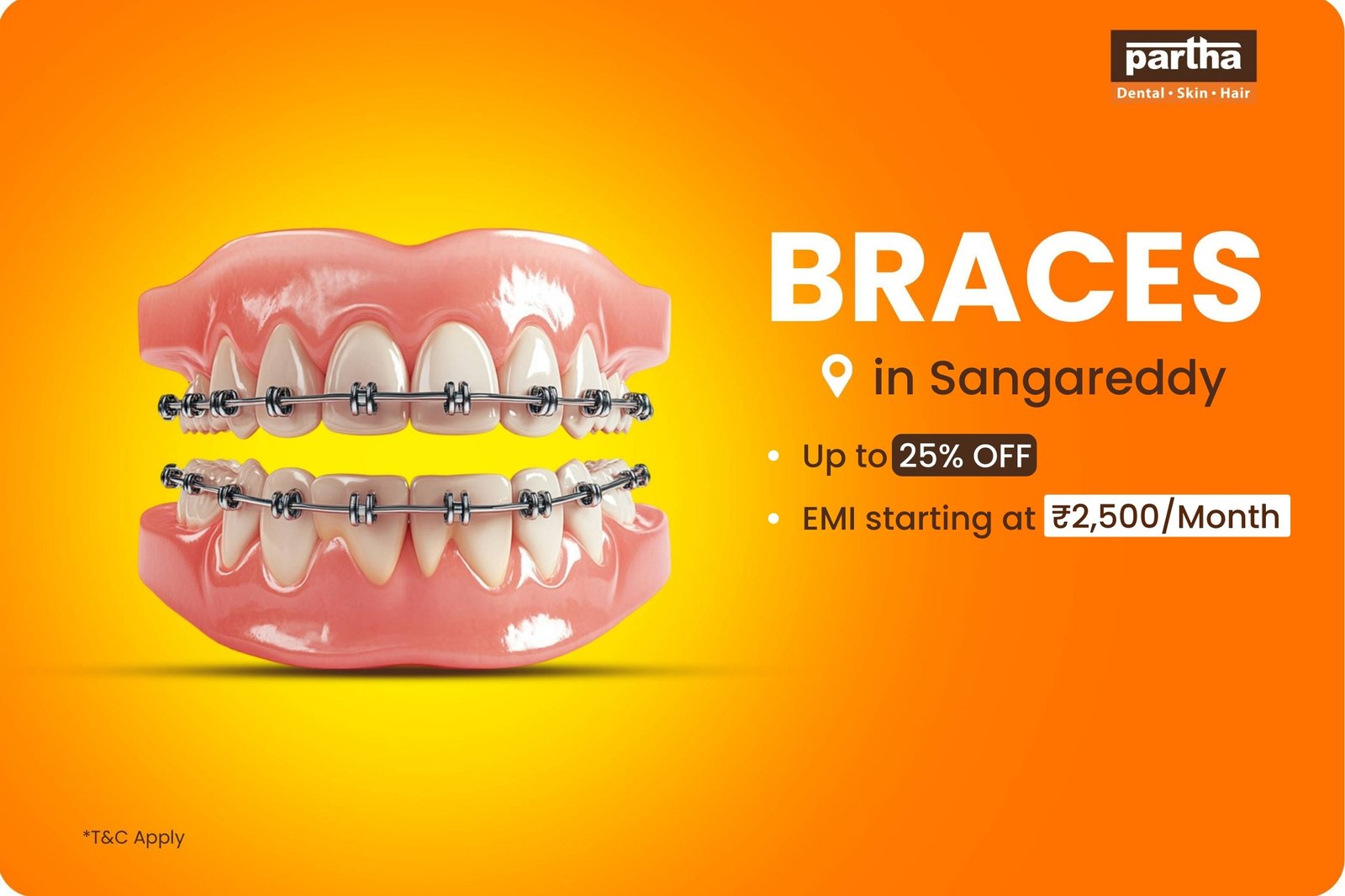
Exclusive Offers on Braces at Partha Dental Clinic
🆓 Free Consultation
🦷 Free X-ray
💸 Up to 20% OFF on Dental Braces
💳 EMI starting at ₹2,500/month
What Are Braces? Understanding the Basics
Braces are dental devices used by orthodontists that are designed to put a soft and stable force on teeth, and over time, to move them into their right places slowly. Though many individuals consider braces as purely a cosmetic treatment for teeth straightening, they still perform a significant health function.
Teeth that are straight are easier to clean, thus lowering the chance of getting cavities and having gum disease. Besides, correctly positioned teeth enhance the person’s bite, which can help to avoid jaw disorders as well as the uneven wearing out of tooth surfaces. For this reason, orthodontists view braces as a health investment instead of just a cosmetic option.
The basic components of traditional braces include metal or ceramic brackets attached to each tooth, an arch wire that holds the brackets together, and tiny rubber bands or ligatures that secure the wire. Over time, as your orthodontist adjusts these components, your teeth gradually shift into alignment.
Who Needs Braces? Common Signs You Should Consider Treatment
Not everyone needs braces, but orthodontic treatment works well for some dental problems. If you see any of these signs in yourself or your kid, it would be a good idea to make an appointment with an orthodontist in Sangareddy city for a consultation.
Crowded Teeth: When teeth don’t have enough space in your jaw, they become crowded, overlapping, or rotating out of position. Crowding is one of the most common reasons people look for braces. Beyond appearance, crowded teeth are harder to clean properly, increasing your risk of plaque buildup, cavities, and gum disease.
Spacing Issues: Large spaces among the teeth can hold food and promote the growth of bacteria, thus increasing the risk of decay. Moreover, the existing teeth may start to move which makes the whole situation worse over time.
Overbite and Underbite: An overbite occurs when your upper front teeth extend too far over your lower teeth. An underbite is the opposite—your lower teeth extend beyond your upper teeth. Both conditions affect your ability to chew properly and can strain your jaw joints.
Crossbite: This is when some of your upper teeth bite inside your lower teeth rather than outside. A crossbite can lead to uneven wear and jaw problems if left untreated.
Open Bite: An open bite means there’s a gap between your upper and lower teeth even when your mouth is closed. This can affect speech and chewing function.
Early evaluation is important and especially for kids. The majority of orthodontists speak about the need for an initial consultation at the age of seven when permanent teeth begin to erupt. One can occasionally manage through prevention the situation before it gets even more difficult and at the same time offer less invasive options down the road.
Book your FREE consultationTreatment Options: Finding the Right Braces for You
Modern orthodontics offers more choices than ever. What works best depends on your specific dental needs, lifestyle, and preferences.
Traditional Metal Braces
Metal braces remain the most popular and effective option for treating complex orthodontic cases. They use stainless steel brackets and wires, often with colored rubber bands that many patients enjoy personalizing.
Metal braces are effective for virtually all types of misalignment and are generally the most affordable option. They’re durable and require fewer adjustments than some alternatives. Many patients, particularly children and teens, appreciate the ability to customize their braces with different band colors.
Ceramic Braces
If appearance is a concern but you want the reliability of fixed braces, ceramic braces offer a discreet alternative. These braces use tooth-colored or clear brackets that blend with your natural teeth, making them less noticeable than metal braces.
Ceramic braces work the same way as metal braces and are equally effective for most cases. The main disadvantage is cost—they’re typically more expensive—and the brackets can stain if not kept clean carefully.
Clear Aligners (Invisalign)
Clear aligners are custom-made, removable trays that gradually straighten your teeth. You wear each set for about two weeks before moving to the next set in your series.
Aligners are nearly invisible, removable for eating and cleaning, and many patients find them more comfortable than braces. However, they work best for mild to moderate crowding or spacing issues. They require excellent compliance—you must wear them 20-22 hours daily—and they cost more than traditional braces. Missing wear time can delay your progress.
Self-Ligating Braces
Self-ligating braces use special clips instead of rubber bands to hold the wire in place. This reduces friction and can sometimes mean fewer adjustments and slightly shorter treatment times. They’re gentler on teeth and tend to be more comfortable, with fewer mouth sores from brackets catching lips and cheeks.
Advanced Digital Braces (3D-Printed Custom Braces)
The latest innovation in orthodontics comes with blending 3D scanning and AI which makes it possible to manufacture personalized braces explicitly made for your distinctive dental structure. Utilizing these sophisticated systems might shorten the duration of treatment by 40% as compared with conventional braces and also less often need the patient to come for adjustments.
Digital scanning replaces uncomfortable traditional impressions with quick, precise 3D imaging. Your orthodontist uses specialized software to plan your exact treatment outcome before braces are even placed, and custom brackets are designed specifically for your teeth.
How Long Does Braces Treatment Take?
Treatment duration varies significantly based on your specific needs, but most patients wear braces for 18-24 months. Some cases take longer, while mild crowding might resolve in 12 months or less.
Several factors influence treatment timeline:
Complexity of your case is the primary factor. Severe crowding, significant bite problems, or multiple spacing issues require longer treatment. Mild to moderate cases progress faster.
Understanding the Comfort Factor: What to Expect
One common concern about braces is discomfort. The good news? Modern braces are far more comfortable than older designs, and any discomfort is usually manageable.
Initial adjustment: You will experience a certain level of tenderness and discomfort during the initial stage of wearing braces and for 3-7 days after every adjustment appointment. This is due to the fact that your teeth are starting to shift. In general, the discomfort is mild to moderate and can be treated with pain relief medications that are available without a prescription.
Mouth sores: Your cheeks, lips, and gums may feel irritated initially as they adjust to the brackets. Applying orthodontic wax to sharp bracket edges protects soft tissues. Most patients adapt within a few days to a week.
Food sensitivity: Your teeth may feel slightly sensitive to pressure initially. Eating soft foods for the first week helps a lot—think yogurt, mashed potatoes, scrambled eggs, soups, and soft pasta.
Long-term comfort: After the initial adjustment period, most patients report minimal discomfort. You’ll likely forget you’re wearing braces except during meals and cleaning.
Modern advances have significantly reduced discomfort compared to braces from previous decades. Among the reasons are the self-ligating brackets that cause a lower level of friction, the ceramic types that give a very smooth feeling, and the digital braces that are made with comfort as the main consideration.
The Cost of Braces treatment at Partha Dental Clinic
| Braces Type | Price in Hyderabad | Visibility | Comfort (Rating /10) | Customization (Rating /10) |
| Metal Braces | ₹30,000 – ₹55,000 | Visible | 7 | 5 |
| Ceramic Braces | ₹40,000 – ₹70,000 | Very slightly visible | 5 | 5 |
| Lingual Braces | ₹75,000 – ₹1,75,000 | Virtually invisible | 10 | 5 |
| Invisalign | ₹100,000 – ₹2,00,000 | Invisible (none visible) | 10 | 5 |
Common Patient Concerns: Addressing Your Worries
“Will braces hurt?” Modern braces are designed for comfort. You’ll feel tenderness for a few days after placement and after adjustments, but severe pain is uncommon. If you experience significant pain, contact your orthodontist.
“Will braces affect my speech?” Temporarily, yes. Most people develop a slight lisp for a few days as their tongue adjusts. This resolves quickly as you adapt.
“How often will I need appointments?” Typically every 4-6 weeks for adjustments. This allows your orthodontist to make gradual, comfortable tooth movements.
“Can I play sports with braces?” Absolutely. A mouth guard protects both your teeth and braces during sports.
“Will my teeth stay straight after braces come off?” Teeth have a natural tendency to shift. That’s why retention is crucial. You’ll wear a retainer afterward, typically every night initially, then several nights per week long-term.
“What about school or work?” Braces fit easily into busy schedules. You’ll quickly adapt to eating, speaking, and maintaining your braces. Many successful adults wear braces.
“Is there any particular age to get braces?” Braces work at any age, though teenagers’ jaws are still developing, which can allow for broader treatment options. Adults benefit from braces equally—it’s never too late.
Why Partha Dental Clinic stands out for Braces Treatment in Sangareddy city?
When seeking braces treatment in Sangareddy town, the quality of your orthodontic care significantly impacts both your treatment experience and results. Several factors distinguish exceptional orthodontic practices at Partha Dental Clinic
- Advanced Diagnostic Technology
- Personalized Treatment Planning
- Comprehensive Orthodontic Expertise
- Commitment to Hygiene and Safety Standards
- Patient-Centred Care Approach
- Our Doctors are recognised as the Best Dentists in Sangareddy
- Trust Through Results and Reviews
Making Your Decision: Quality over Cost Alone
While cost is a legitimate consideration, choosing an orthodontist based solely on price often leads to regret. The cheapest option doesn’t guarantee the best results. More importantly, excellent orthodontists typically charge competitive prices because they operate efficiently, not because they cut corners on care quality.
When evaluating braces clinics in Sangareddy, consider the complete package: the orthodontist’s expertise and training, the clinic’s technology and hygiene standards, the personalized approach to your care, the quality of patient communication, and the visible results they achieve. These factors, combined with fair pricing, indicate a practice worth choosing.
Conclusion: Your Path to a Confident Smile
Braces treatment is a significant decision, but it’s also an exciting journey toward improved oral health, better function, and increased confidence in your smile. Understanding what to expect—from initial consultation through treatment completion—helps you make informed decisions and feel prepared.
What are braces and why do I need them?
Braces help straighten crooked teeth, fix gaps, and correct bite problems to improve smile, chewing, and oral health.
At what age can I get braces?
Braces can be done at any age. Children, teenagers, and adults can all undergo orthodontic treatment.
How long does braces treatment take?
On average, treatment lasts 12 to 24 months, depending on tooth alignment and bite issues.
Are braces painful?
You may feel mild discomfort for a few days after fixing or adjustments, but it settles quickly.
What foods should I avoid with braces?
Avoid hard, sticky, and chewy foods like nuts, chewing gum, popcorn, and hard candies.
FAQs
Braces help straighten crooked teeth, fix gaps, and correct bite problems to improve smile, chewing, and oral health.
Braces can be done at any age. Children, teenagers, and adults can all undergo orthodontic treatment.
On average, treatment lasts 12 to 24 months, depending on tooth alignment and bite issues.
You may feel mild discomfort for a few days after fixing or adjustments, but it settles quickly.
Avoid hard, sticky, and chewy foods like nuts, chewing gum, popcorn, and hard candies.
Dental Questions? We’re here to help!
Disclaimer:
The prices mentioned in this blog are indicative and may vary based on the severity of the condition, the technology used, and materials recommended by the dentist. They are accurate as of the date of publishing and are subject to change based on clinic policy. Third-party or AI-generated estimates may not reflect actual clinic pricing. For accurate cost details, please visit your nearest Partha Dental clinic.