














Yes, invisible braces are possible even if you already have crowns or caps on your teeth. In many cases, the tooth under the crown can move safely when our dentists plan the treatment properly and check the fit of the crown, the health of the tooth, and your bite before starting.
At Partha Dental, our specialists guide you with clear aligners, tooth braces, digital scan planning, and crown assessment in one place, so you know which option will work safely and give you the right smile result.
Read further to understand when invisible braces with crowns work fine, when they need extra planning, and what our dentists may suggest in your case.
Can You Get Invisible Braces If You Already Have Crowns Or Caps?
Yes, you can. A crown on a tooth does not automatically rule out aligners or braces. What matters more is the condition of the crown, the health of the tooth under it, and the type of movement your smile needs.
Our dentists check these points first:
- The crown sits firmly on the tooth.
- The tooth under the crown stays healthy.
- The gums around it look stable.
- The bite does not overload that tooth.
- The planned movement stays realistic.
If a crown feels loose, old, bulky, or poorly shaped, we may first fix that issue before we move the tooth. That protects your result and reduces problems during treatment.
Can Crowns Move With Braces Or Clear Aligners?
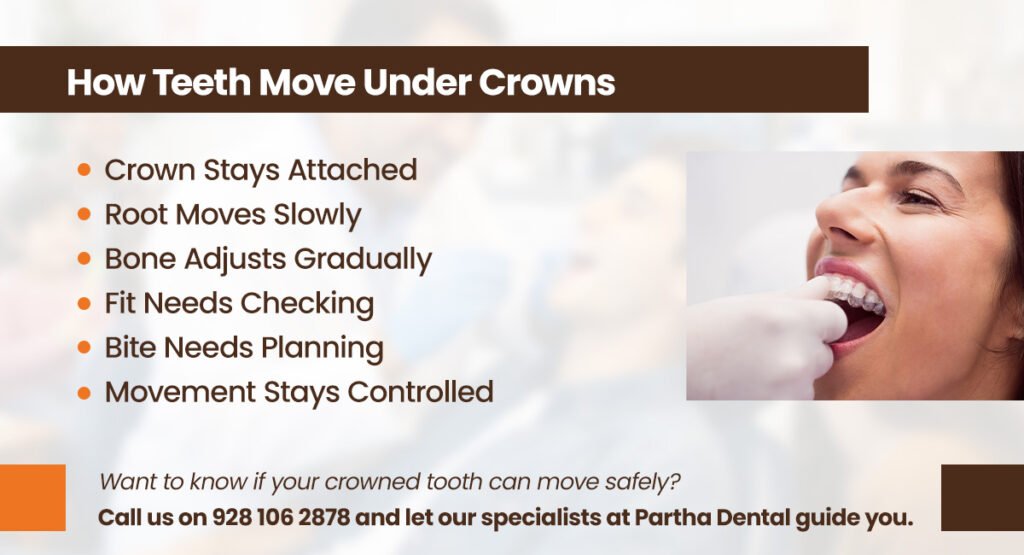
This is the question most people really want answered. Can crowns move with braces? Yes, but the crown itself does not slide over the gum or bone on its own. The real movement happens in the natural tooth root under the crown. Since the crown stays attached to that tooth, it moves with it as one unit.
Think of it in a simple way. The crown acts like a cover on the tooth. The cover does not travel separately. The whole tooth moves when steady orthodontic force acts on the root.
What Will Our Dentists Check Before Recommending Invisible Braces On Crowned Teeth?
Before we suggest aligners, we study more than the crown surface. We need to know whether the tooth can handle movement and whether the crown can stay stable during treatment. This step matters because a well-fitted crown behaves very differently from one that already feels weak.
We check:
- Crown fit and cement stability.
- Gum health around the tooth.
- Root support inside the bone.
- Bite pressure on that area.
- Number of crowned teeth in the mouth.
- Need for scans or X-rays before planning.
- Whether attachments can bond safely.
This careful review helps us decide whether clear aligners will work well, whether regular braces will control the case better, or whether a crown needs attention before treatment begins.
When Do Clear Aligners Work Well For Teeth With Crowns?
Clear aligners work best when your movement goal stays moderate and your crowned tooth remains stable. If you want to correct mild crowding, small spacing, or cosmetic alignment, aligners work well. They also suit patients who want a better option and can wear the trays as advised every day.
Aligners work well when:
- The crown fits properly.
- The tooth root stays healthy.
- The movement stays mild to moderate.
- Your bite does not need major correction.
- You can wear trays for the required hours.
This is why many adults with one or two crowns still move ahead with aligner treatment after a proper assessment.
When Are Regular Braces Better Than Invisible Braces For Crowned Teeth?
Aligners are not always the best answer. Sometimes braces give us better control, especially when your bite needs bigger correction or the tooth needs stronger grip.
| Situation | Better Option In Many Cases |
| Mild crowding or spacing | Clear aligners |
| Cosmetic alignment with stable crowns | Clear aligners |
| Severe crowding or heavy rotation | Regular braces |
| Complex bite correction | Regular braces |
| Limited attachment grip on crown surface | Regular braces |
If your case falls in the difficult zone, we will tell you that clearly. The aim is not to push one option. The aim is to move your teeth safely and predictably.
What Problems Can Affect Invisible Braces On Teeth With Crowns?
Most problems do not come from the crown simply existing. They come from the condition of the crown or from the type of movement the case needs. Attachments may not bond to crown material as easily as they bond to natural enamel. That can affect grip and force delivery in some cases.
Problems we watch for include:
- Old or loose crowns.
- Short crown height.
- Poor crown shape.
- Weak bonding for attachments.
- Gum margin irritation.
- Bite interference during movement.
These issues do not always stop treatment. They simply mean your case needs more careful planning and closer follow-up.
Do You Need To Change Old Crowns Before Or After Invisible Braces?
Not always. If the crown fits well and the tooth remains healthy, we can keep it during treatment. But if the crown looks loose, worn, bulky, or badly shaped, we may advise changing it either before treatment or after alignment finishes.
We may leave the crown in place when:
- It fits well.
- It seals the tooth properly.
- It does not interfere with movement.
We may advise replacement when:
- It has poor margins.
- It looks old or damaged.
- It affects the final bite or smile line.
This is where dental crowns in Hyderabad can become part of the full treatment path. Sometimes straightening first and replacing the crown later gives you the best final fit and smile.
How Does Treatment Work At Partha Dental If You Have Crowns And Want Invisible Braces?
We keep the process clear and step by step. First, we examine the crowned teeth and the bite. Then we take digital records and decide whether aligners or braces suit your case better. After that, we plan movement that respects the crowned teeth instead of forcing a standard approach.
Here is how treatment moves:
- We check the crown, bite, and gum support.
- We take digital scans and records.
- We decide if aligners or braces suit your case.
- We plan attachment use with extra care.
- We monitor crowned teeth closely during movement.
- We review whether any old crown needs correction at the end.
If you are considering braces treatment in Hyderabad, this kind of step-by-step planning matters because your crowned teeth need more than a generic smile correction plan.
Get Expert Guidance For Invisible Braces With Crowns At Partha Dental
If you want a straighter smile but already have caps or crowns, do not keep guessing what is safe. At Partha Dental, we check crown fit, bite, root support, and treatment options before we move a single tooth. We offer clear aligners, tooth braces, digital scan planning, and crown review in one place so your plan feels safe. If old crowns need correction or your bite needs a different approach, we will tell you honestly.
Call us on 801 955 0000 or message us on WhatsApp at 942 942 2020 and let Partha Dental guide your treatment safely.
FAQs
Can you get invisible braces if you already have crowns?
Yes, you can get invisible braces with crowns if the crown fits well and the tooth under it stays healthy. Our dentists first check stability before planning treatment.
Can crowns move with braces or aligners safely?
Yes, can crowns move with braces depends on the tooth root. The crown moves with the tooth when the root is healthy and force is controlled.
Will invisible braces damage my dental crown?
No, aligners use gentle pressure and usually do not damage crowns when we plan the case properly and monitor it closely.
Do you need to replace crowns before starting braces?
You do not always need replacement. We suggest changing a crown only if it feels loose, damaged, or affects the final bite.
Are aligners better than braces for teeth with crowns?
Aligners work well for mild cases. Braces may suit better for complex bite correction or when stronger control is needed.