












When Is Gum DIsease Treatment Needed?
Your gums tell you early. They bleed when you brush. They feel puffy. Food packs between teeth where it never used to. These changes creep in slowly, so patients often wait too long.
- Bleeding gums during brushing or flossing, even gently
- Persistent bad breath that mouthwash does not fix
- Gums pulling back from teeth, making them look longer
- Loose or shifting teeth that feel different when you bite
- Pus between teeth and gums or a constant metallic taste
- Tender, red, or swollen gum tissue that does not calm down
- Deep pockets forming where gum meets tooth
A dentist confirms the stage with a periodontal probe and X-rays. Only then can the right plan be set.
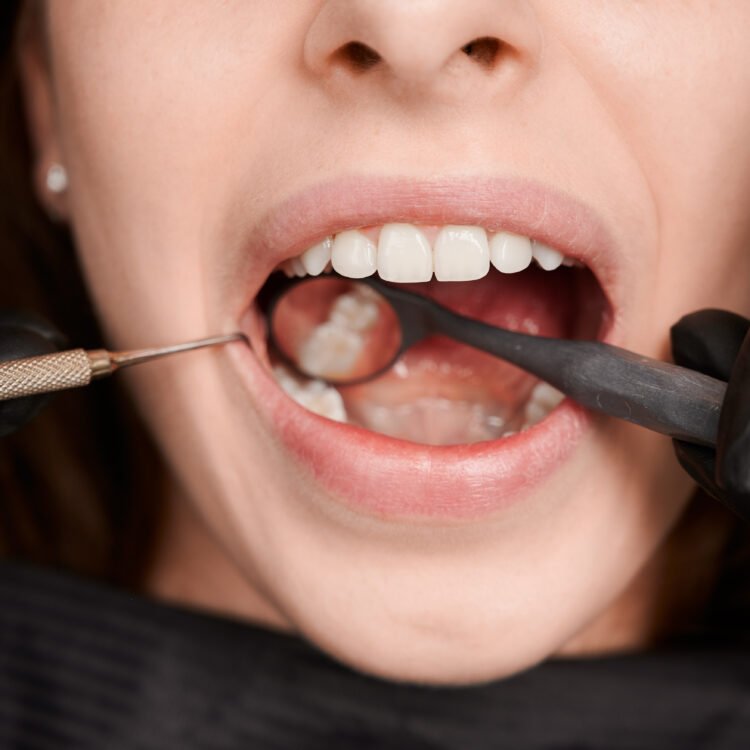
Non-Surgical vs Surgical Gum Treatment
The choice depends on pocket depth, bone loss on X-ray, and how much tartar sits below the gumline. Early disease responds to cleaning. Advanced disease needs more.
- Scaling and root planing: deep cleaning for pockets up to 5mm, done under local anaesthesia
- Flap surgery: lifts gum to reach deep tartar and reshape bone, used for pockets beyond 5mm
- Bone grafting: adds material where bone has been destroyed, paired with surgery
- Gum grafting: covers exposed roots when recession is severe
- Laser-assisted therapy: removes diseased tissue with less cutting for select cases
- Maintenance schedule: non-surgical cases need recall every 3-4 months; surgical cases need closer follow-up initially
How Partha Dental Carries Out Gum Care
- The dentist measures pocket depths with a calibrated probe at six points per tooth.
- A full mouth X-ray, usually a panoramic film, maps bone levels.
- The hygienist or periodontist administers local anaesthesia before scaling begins.
- Ultrasonic scalers remove tartar above and below the gumline.
- Hand instruments smooth root surfaces so bacteria cannot reattach easily.
- The dentist irrigates pockets with antimicrobial solution where indicated.
- You receive a written recall plan, typically every 3 months for the first year.
What to Expect During Recovery
Most patients return to work the same day after scaling. Surgical cases need 2-7 days before normal eating resumes. Swelling peaks at 48 hours. The dentist prescribes specific mouth rinses and modified brushing for the healing period.
- First 24 hours: avoid hot drinks, alcohol, and vigorous rinsing
- Days 2-3: salt water rinses twice daily, soft diet only
- Week 1: brush carefully with a soft brush, avoiding surgical sites
- Week 2: most swelling subsides; stitches dissolve or are removed
- Month 1-3: pockets are remeasured to check healing
- Call the clinic if bleeding restarts, pain worsens after day 3, or fever develops
What Happens If Gum Disease Is Left Untreated?
Bacteria in deep pockets continue destroying the ligament and bone that hold teeth in place. Teeth loosen. Chewing becomes painful. Infection can spread to adjacent tissue. The damage is gradual but often irreversible without intervention. Early treatment preserves what bone remains.
Why Patients Choose Partha Dental in AS Rao Nagar
- BDS and MDS qualified periodontists handle cases in-house, not referred out
- NABH-accredited protocols govern sterilisation and instrument processing
- 40+ branches across Telangana, Andhra Pradesh, Karnataka and Tamil Nadu for follow-up if you relocate
- Same-week appointments available for acute gum infections
- Written treatment plans with phased options so you decide the pace
- EMI options discussed at the planning stage for surgical cases
Book Gum Care Near You in AS Rao Nagar
Call the branch closest to you. The receptionist checks availability and explains what to bring: any recent X-rays, a list of medications, and your preferred time slot.
- Hyderabad, Telangana: 090306 22077